
The History of Treasure of the Rudras
Treasure of the Rudras (Rudra no Hihou, Super Famicom, April 5, 1996) is Square’s Osaka division’s end of the world RPG: every 4,000 years a Rudra destroys the ruling race and replaces it, and humanity has fifteen days left. Four heroes, Sion, Surlent, Riza, and Dune, receive the Jades of dead Rudras and spend those days trying to break the cycle. It was directed by Kouji Ide, designed visually by Keita Amemiya, and scored by Ryuji Sasai. It has never been officially released outside Japan. Its signature is the mantra system, in which players write their own spells.
THE BOX
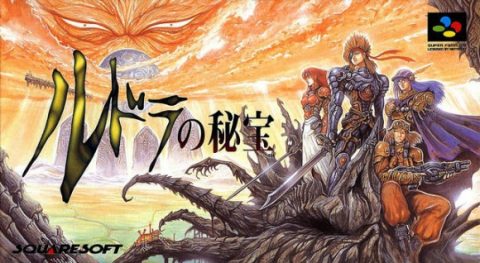
No Western box exists and none is substituted here. The staged file is 480px wide, below the Library’s working standard, and is a swap-in upgrade when a larger scan is verified.
THE MAKING
Osaka, 1993 to 1996, starting from the magicProduction began in 1993 and lasted three years in Square’s Osaka division, staffed by veterans of Final Fantasy Legend III and Final Fantasy Mystic Quest. Ide’s team started by conceiving the magic system itself, grounding it in kotodama, the power of words, and in Japan’s cultural appreciation for wordplay. Battle planner Masahiro Kataoka proposed that players could exchange discovered words with their friends as a way to progress, and the game was designed for that exchange.
The divisions of Square did not typically interact, so although the game was developed alongside Final Fantasy VI, its field planner Masato Yagi, hired in 1994 and given freedom over the maps, has explained that the team based its technology on 1992’s Final Fantasy V. While other studios chased 3D, this team answered with 2D craft: lead monster designer Yuichirou Kojima animated the enemy sprites, normally still images in Square RPGs, and programmer Shingo Tanaka gave the party constant movement in combat to keep long battles stress free. Keita Amemiya, advertised from the start, formally joined a year and a half before completion, amending an outline the team had already set, with his studio Crowd Inc.
THE DESIGN
Three stories, fifteen days, one grimoireThe story runs in three scenarios, the soldier Sion, the priestess Riza, and the archaeologist Surlent, playable in any order, with the freedom to leave one storyline and follow another. The fifteen days pass on a fixed day and night cycle, and the scenarios touch each other: a relic one party leaves behind can be found by another party on a later day. Finishing all three opens a fourth scenario led by the thief Dune, gathering every hero for the confrontation on the Moon.
Magic is the design’s center. Spells are not learned by level; they are written into a grimoire as words of up to six characters, built from prefixes, elemental cores, and suffixes, and every entered word does something, useful or not. The full working of the system is on this shelf’s question page.
THE MUSIC
Sasai’s 58 tracksRyuji Sasai, who had co-composed Final Fantasy Mystic Quest, wrote an orchestral leaning rock score of 58 tracks. The soundtrack CD followed within weeks of the game, released by NTT Publishing on April 25, 1996, with a piano sheet music edition from Doremi in 1997 transcribing every track, and a digital reissue in 2008. Individual pieces kept surfacing on Square Enix compilations for years afterward, the regular battle theme in 2007, an arranged boss theme in 2012, and the opening theme in 2021, a long tail for a game most of the world could not buy.
THE EDITIONS
One release, carried by fansTHE RECEPTION
A Silver Hall of Fame score, a hidden gem afterTHE LEGACY
The last one Square itself developedTreasure of the Rudras is documented as the last game Square developed for the Super Famicom, a claim it shares confusingly with Treasure Hunter G, the last game Square published for the system; this shelf’s question page separates the two claims. Its reputation in the West rests entirely on the fan translation and on the mantra idea, which remains close to unique in console RPGs: a magic system that treats the player’s vocabulary as the spell list, designed from the start so that friends would trade words the way they traded rumors.