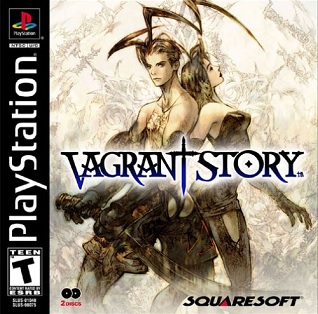
The History of Vagrant Story
Vagrant Story (PlayStation, 2000) is Yasumi Matsuno's one man dungeon: a single agent, a ruined city, no party, no shops, and a combat system built on crafting the weapon for the enemy in front of you. Famitsu gave it 40 out of 40, a perfect score the magazine had handed to very few games. It sold modestly anyway, released into the most crowded season in its publisher's history, and became the connoisseur's Square game of the PlayStation era.
THE MAKING
The Tactics team learns 3D, 1998 to 2000Vagrant Story was developed primarily by the team responsible for Final Fantasy Tactics, with Matsuno as director, producer, designer, and writer, Akihiko Yoshida and Hiroshi Minagawa on art, and Hitoshi Sakimoto composing. Matsuno preferred building a new title from scratch and staff collaboration to reusing popular characters, and resisted filing the result under any existing genre, calling it, in effect, a genre of its own, part RPG, part action game, part dungeon crawl.
The technical ambition was the risk: a fully polygonal world at the end of the PlayStation's life, with the same character models carrying event scenes and gameplay so the camera never has to cut away. Minagawa has noted that painstaking detail went into every model, including characters who appear for a few seconds. The setting, the ruined city of Leá Monde in the kingdom of Valendia, sits in the world of Ivalice that Matsuno had created for Tactics.
THE DESIGN
One Riskbreaker, every weapon a projectAshley Riot, an elite agent called a Riskbreaker, enters Leá Monde alone to pursue the cult leader Sydney Losstarot, and the game never gives him company. Combat is pausable real time: target a body part, chain timed attacks and defensive reactions, and manage the Risk meter that makes every long combo a wager. Weapons are disassembled, combined, and specialized by enemy class, material, and element, so the inventory itself is the character build.
The English edition is part of the design's reputation. Localizer Alexander O. Smith rendered straightforward Japanese into a deliberately archaic, elevated English, and the translation is routinely cited among the finest of its era, the rare case where the localized script is the famous one.
THE EDITIONS
Two discs in America, one of them a samplerTHE RECEPTION
Perfect in Japan, admired in the WestTHE LEGACY
The admired siblingVagrant Story never received a sequel, and Matsuno's next game took its team to Final Fantasy XII, which carried Vagrant Story's vocabulary with it: Riskbreakers, Leá Monde, and Kildea all surface there. What remains is the reputation inversion the numbers created, the Square game of 2000 that critics scored highest relative to its sales, and a standing request, renewed at every anniversary, for the remaster that has never come.
THE GAME ON THE SHELF
Vagrant Story, 2000