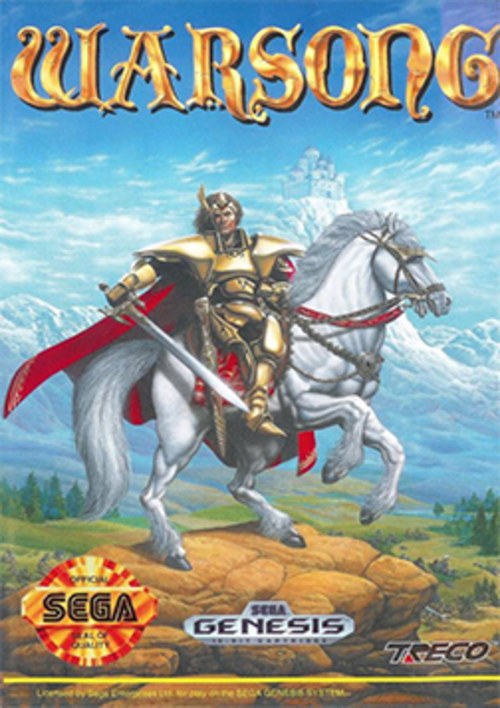
The History of Warsong
In Japan it is Langrisser (Mega Drive, April 26, 1991), the first game of Masaya's long tactical series. In America it is Warsong (Genesis, March 1992), published by Treco, and for three decades it was the only Langrisser most Western players could buy. The music is by Noriyuki Iwadare, Isao Mizoguchi, and Hiroshi Fujioka, the series' artist is Satoshi Urushihara, and the developer is Masaya's Team Career.
THE MAKING
Wargame makers build an RPG of armiesTeam Career came to Langrisser from wargames: their earlier Elthlead games (1987 onward) already staged Sieghart's battles against the dark god's avatar Böser, the backstory this game inherits. What they built set the series apart from other tactical RPGs of its time by scale: battles where the player can field over thirty units at once against scores of enemies (Tier 2: the series reference record and Hardcore Gaming 101's series history).
The story follows Prince Garett of Baltia (the names are the American ones; Treco's edition renamed the cast) fleeing a fallen castle, retaking the magic sword Warsong, and learning that the empire that stole it has awakened Chaos itself, which delivers the genre's most philosophical exit line of 1991: order and chaos were made by the world to keep it in balance, and chaos will return while humans keep fighting.
THE DESIGN
Commanders, troops, and a radius of commandThe unit of play is not the hero but the squad. Before each scenario the player hires up to eight troops per commander, chosen from types the commander's class allows. Troops fighting inside their commander's range receive attack and defense bonuses; troops recover by standing around their commander; a commander who falls takes the squad's strength with him. Terrain affinity does the rest: fliers beat soldiers and lose to bowmen, soldiers beat pikemen and lose to cavalry, cavalry beats soldiers and loses to pikemen.
Commanders gain experience and change class along branching paths, spells included. A hero who dies is lost forever, and if Garett dies the game ends, stakes the hired troops make heavier: every scenario is an economy as much as a battle.
THE EDITIONS
Langrisser travels, Warsong stays homeTHE RECEPTION
A cult classic with a documented prosecutionBoth records stand because both are the evidence: a small, devoted Western audience that rates the game near Phantasy Star IV, and a specialist press verdict that the first game is the series' rough draft. The sales and review archive for 1991 to 1992 is thin in English, and this page does not invent scores it could not open.
THE LEGACY
The door the West left closedUntil 2016 the original Langrisser was the only game in its series officially localized into English. Langrisser II, III, IV, and V played out on Mega Drive and Saturn in Japan while Western players made do with fan translations. The series returned officially with the 3DS revival in 2016, Langrisser Mobile in 2019, and the I & II remakes in 2020. Warsong is therefore two artifacts at once: a foundational tactical RPG, and the visible tip of a five game series that stayed on the far side of the language line. That shape, a giant in one market and a footnote in another, is the Genesis shelf's own small version of the pattern this Library documents at full size on the PC Engine shelf.
THE GAME ON THE SHELF
Warsong, the one Western release