
The History of WWF WrestleMania 2000
WWF WrestleMania 2000 is a professional wrestling game developed by AKI Corporation and published by THQ for the Nintendo 64, released in North America on 18 November 1999, with a Game Boy Color version by Natsume alongside it. Asmik Ace published the Japanese Nintendo 64 edition on 15 September 2000.
Despite its name, the game beat its own pay-per-view to the shelves by five months, so its big stage is the set of WrestleMania XV, the 1999 event.
HOW IT WAS MADE
AKI Corporation, 1999WrestleMania 2000 exists because of the game in the previous gallery door. The WWF had watched WCW's AKI games sell for THQ while its own Acclaim titles lagged, and it ended its long Acclaim relationship to sign with THQ. This was the first WWF game THQ released, and AKI built it on the engine of WCW/nWo Revenge, carried across the battle lines intact.
The additions were structural. The cage match and First Blood match appeared for the first time. Create-a-Wrestler arrived in a THQ Nintendo 64 title for the first time, stocked with move sets carried over from the AKI back catalogue, so complete that WCW wrestlers THQ no longer had the rights to could be rebuilt from parts. For the first time in a WWF game, the built-in wrestlers themselves could be freely edited, each with four attire templates that could be rewritten and swapped. Players could create their own pay-per-views with television presentation, and mint up to eight championship belts to defend in exhibition.
Road to WrestleMania mode ran a rookie up the ladder through feuds, run-ins, and interruptions toward the main event of WrestleMania, with a rule that gave it teeth: hold four championships and you defended all four at one pay-per-view. The roster passed fifty wrestlers, including six immediately playable women, a first for a WWF game. Its cast is a time capsule that neither its predecessor nor successor shares: the only THQ WWF game with Droz, and the only appearances for several wrestlers whose runs ended that year.
The marketing matched the Attitude Era's volume. In the television commercial, The Rock discovers the game carries his name, likeness, and move set, and threatens to shove copies of it up Santa Claus's candy ass. Some copies shipped with a special card of four holograms showing entrances and finishers.
THE TWO COVERS
Same five faces, two treatments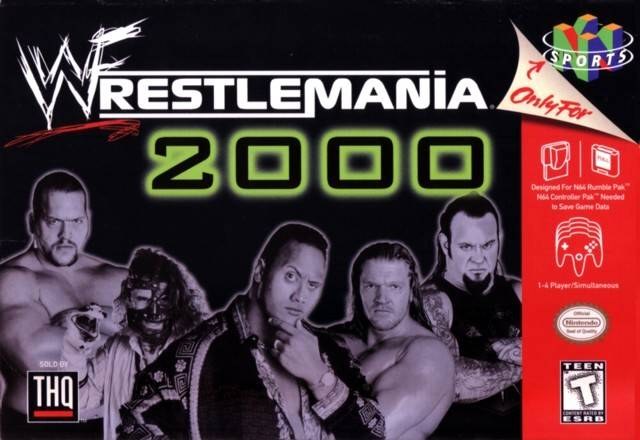
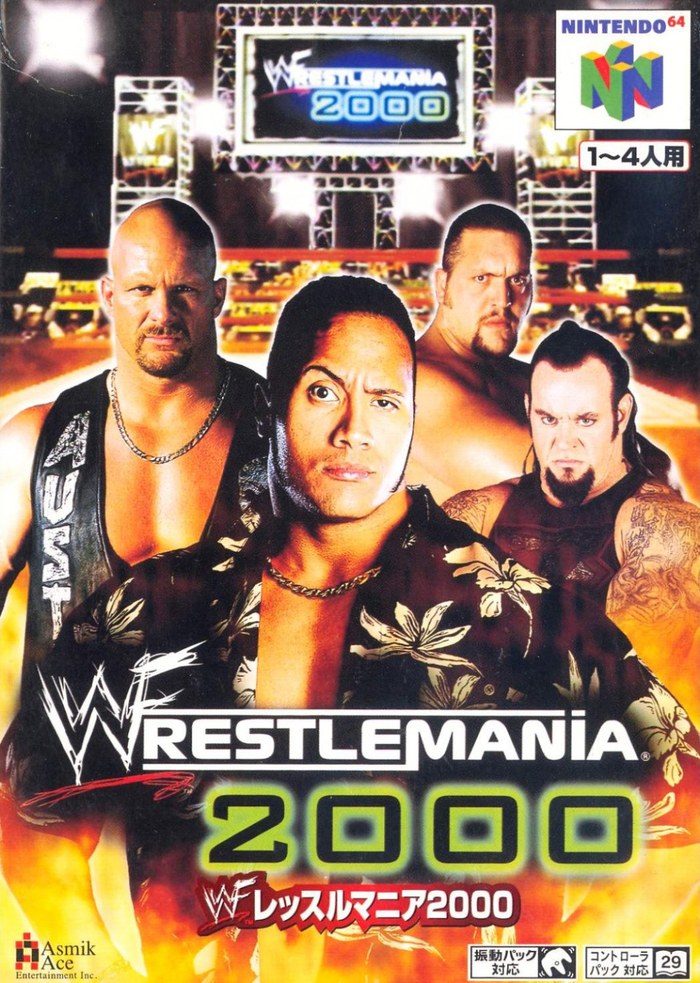
THE RELEASE
November 1999, and a late trip to JapanThe game released in North America on 18 November 1999 and in the United Kingdom on 10 December 1999. Japan's edition, published by Asmik Ace, followed on 15 September 2000, nearly a year later and months after Virtual Pro Wrestling 2 had already carried the same engine further at home. Contemporary Japanese coverage noted the import was barely localized, its menus and move lists left largely in English.
HOW IT WAS RECEIVED
The scoresTHE SALES
Documented figuresWrestleMania 2000 sold more than one million units by January 2000, inside its first two months on sale. In the final edition of Nintendo Power, it was ranked 223rd on the magazine's list of the best games released on Nintendo consoles, cited for its massive roster and positive gameplay.
WHAT IT LEFT BEHIND
The door to No MercyWrestleMania 2000 proved the WWF license and the AKI engine belonged together, and it set the checklist its successor would complete: the branching stories, the shop, the backstage. A year later, No Mercy took every system this game introduced and deepened it. It is the next door but one in this gallery, and the one the whole shelf bends toward.