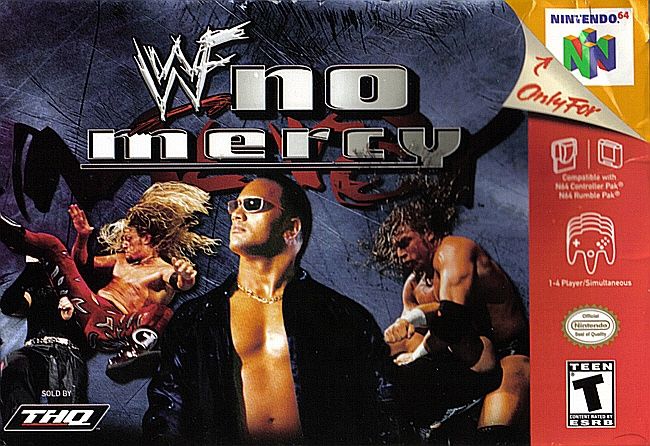
What was the AKI engine, and why did its wrestling games feel different?
The engine was AKI Corporation's house system, refined across a run of Nintendo 64 games: WCW vs nWo: World Tour in 1997, WCW/nWo Revenge in 1998, WWF WrestleMania 2000 in 1999, and WWF No Mercy in 2000, with the Virtual Pro Wrestling line running parallel in Japan. Its controls were radically simple. Tap the button for a weak grapple, hold it for a strong one. Add a direction to choose the move. Almost nothing had to be memorized, because the thinking was in the timing, not the inputs.
The genius was in what the engine refused to allow. Early in a match, strong grapples are easily reversed, so a player who opens with finishers gets countered and embarrassed. Damage accumulates invisibly, body part by body part, and shows itself in how a wrestler clutches a limb or slows down. Only a worn-down opponent stays down in the big moves. Matches therefore had the shape of real wrestling cards: work the man, then finish him.
Above it all sat the spirit meter, inherited from the first Virtual Pro Wrestling in 1996, where it replaced the health bar outright. Momentum, not health: land offense and taunt to raise it, take a beating and it drains. Fill it, and a strong grapple plus a flick of the stick hits your finisher, the screen flashing SPECIAL. Shoulder buttons blocked strikes and reversed grapples, so defense was a read, not a prayer. The result was a game that played at wrestling's pace: deliberate, physical, psychological.
The run ended with the console, not the quality. When the Nintendo 64 generation closed, THQ's next-generation WWF games went to Yuke's and the faster SmackDown style. An AKI sequel to No Mercy, named for WWF Backlash, was begun and cancelled. The engine itself walked across the street: AKI's team built Def Jam Vendetta in 2003 and Def Jam: Fight for NY in 2004 for EA, hip-hop brawlers that fans treat as the engine's spiritual sequels. AKI renamed itself Syn Sophia in 2007. The engine never came back to wrestling, and nothing since has quite replaced it.
HOW IT WORKED
The system, piece by piece