
The History of WWF No Mercy
WWF No Mercy is a professional wrestling game developed by Asmik Ace Entertainment and AKI Corporation and published by THQ for the Nintendo 64 in 2000. Directed by Hideyuki Iwashita, it closed the run of AKI wrestling games that began with WCW vs. nWo: World Tour in 1997.
It arrived carrying the deepest single player mode the series had attempted, a new shop for unlockables, and one notorious flaw: its first cartridges could erase a player's save data without warning. Both the triumph and the flaw are part of the same story, and both are documented on this shelf.
HOW IT WAS MADE
AKI Corporation and Asmik Ace, 2000The game was first announced in early 2000, and a playable demo was exhibited at that year's E3, showing several wrestlers and the arena built for the WWF's SmackDown! television show. Kenji Kimura designed the game and Kouji Niikura composed its music.
On top of the engine AKI had refined across three earlier games, No Mercy layered the series' biggest additions. Championship mode offered seven selectable story paths, one per championship, with branching routes decided by wins, losses, and choices made along the way. The SmackDown Mall turned progress into currency: characters, arenas, moves and costumes were bought with money earned in the ring, including in the new survival mode. The ladder match appeared for the first time, and No Mercy was the first and only AKI game to let players brawl backstage, through areas stocked with weapons and objects.
The roster passed sixty playable wrestlers, and the create-a-wrestler mode grew deeper than any predecessor's: more moves, more body attributes, female wrestlers for the first time, and room for eighteen saved originals, alongside free editing of the built-in roster.
A companion Game Boy Color game was announced alongside it, designed to use the Transfer Pak so points earned on the handheld could be spent in the SmackDown Mall, with an extra Championship storyline of its own. The handheld game was cancelled, and the Transfer Pak features were dropped from the Nintendo 64 version.
THE COVERS
One box, two continents, none in Japan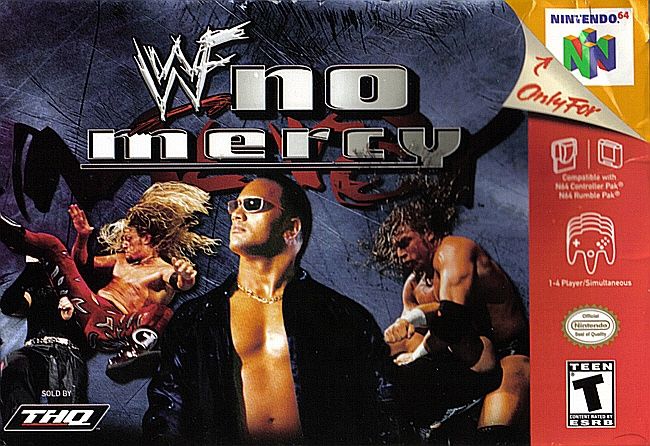
THE RELEASE
November 2000, and the flawNo Mercy released in North America on 14 November 2000 and in Europe on 15 December 2000. Soon after release, players reported that the initial line of cartridges could inexplicably erase save data at any time.
THQ first recommended resetting the cartridge to factory defaults. When reports continued, the company instituted an exchange program: affected owners could swap their copy for a fixed one. Because the corrected cartridges only ever circulated through that exchange, they are exceedingly rare today and sell for hundreds of dollars. The full story of the glitch has its own page on this shelf.
HOW IT WAS RECEIVED
The scoresTHE SALES
Documented figuresNo Mercy sold over one million copies, making it the third best-selling wrestling game on the Nintendo 64, behind its own predecessors WrestleMania 2000 and WCW/nWo Revenge. A console's wrestling shelf rarely belongs so completely to one developer.
WHAT IT LEFT BEHIND
The benchmarkNo Mercy was the last wrestling game Asmik Ace and AKI made for the Nintendo 64. AKI's later Def Jam Vendetta and Def Jam: Fight for NY, made for Electronic Arts, are treated by fans as its spiritual successors.
The tributes kept coming from inside the industry. In 2013, WWE Games creative director Cory Ledesma said: “To this day, I still hear, 'Why can't you make the new WWE games like No Mercy,' and I don't think I'm ever going to stop hearing that.” In 2009, Official Nintendo Magazine placed it 70th on its list of the greatest Nintendo games. Iwashita himself signed on in 2020 as a consultant on AEW Fight Forever, a game built in No Mercy's image, and in September 2023 WWE's NXT opened its No Mercy event with a cold open recreating the game's intro. A quarter century of fan modifications has kept the cartridge current long after the console left the shelves.