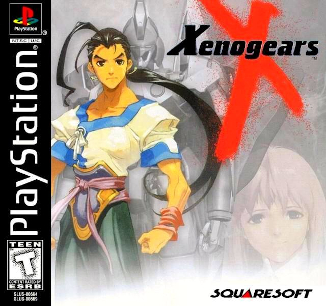
The History of Xenogears
Xenogears (PlayStation, 1998) is the middle chapter of a six episode, ten thousand year science fiction saga, and the only chapter ever made as a game. Created by Tetsuya Takahashi and Kaori Tanaka, it mixes giant robots with Jungian psychology and a plot that takes on organized religion directly. It shipped 1.19 million copies by 2003, was never released in Europe in its era, and its unfinished looking second disc became the most debated production story on the console, until Takahashi told it himself.
THE MAKING
A proposal too dark for Final Fantasy, 1994 to 1998Takahashi and Tanaka conceived the story in 1994 and pitched it as a proposal for Final Fantasy VII. Their superiors judged it "too dark and complicated for a fantasy" and let Takahashi develop it separately instead. The project, working title Project Noah, was at one stage planned as a sequel to Chrono Trigger before becoming an original science fiction game. Hiromichi Tanaka produced; Masato Kato joined the writing; Kunihiko Tanaka designed the characters, Junya Ishigaki and Yoshinori Ogura the Gears, and Yasuyuki Honne directed the art. Yasunori Mitsuda composed.
The team was, by Takahashi's later account, staffed almost entirely with young, new employees, working under Square's rule that all projects take two years, while learning brand new 3D production as they went. The schedule slipped, and what happened next is told in full on this Library's second disc page, from Takahashi's own 2017 interview: Square suggested ending the game at disc one, and Takahashi proposed the narrated second disc instead, to finish the story with the staff, time, and budget remaining.
THE DESIGN
Sprites in 3D worlds, fists and GearsXenogears inverts its era's house style: where Final Fantasy used 3D models on painted backgrounds, Xenogears walks 2D sprites through fully 3D environments with a rotating camera, and tells its biggest scenes in hand drawn anime cutscenes rather than computer graphics. Combat runs twice, on foot, where combos are built from strong, medium, and weak attacks, and in Gears, giant mecha whose fuel gauge replaces magic points and makes every big attack a budget decision.
The story is the design. Fei Fong Wong, an amnesiac painter in a mountain village, is a protagonist built from Freudian and Jungian parts, with past lives, split identities, and a ten thousand year conspiracy run through a church that is not what it claims to be. The game was almost not localized at all because of its religious content; translator Richard Honeywood, who handled it, has called it one of the most troublesome games of his career.
THE EDITIONS
Two discs and the book that explains themTHE RECEPTION
Acclaim with an asteriskTHE LEGACY
The saga that left Square with its makersXenogears ends by announcing itself as Episode V. Perfect Works maps Episodes I through VI, and none of the other five was ever made as a game. Square's focus settled on Final Fantasy; Takahashi disagreed, left, and in 1999 founded Monolith Soft, where the Xeno ideas continued as spiritual successors: the Xenosaga trilogy at Namco, then the Xenoblade games at Nintendo. The 1998 original remains the densest single telling, a two disc fragment of a six part design that its book, not its sequels, completed.
THE GAME ON THE SHELF
Xenogears, Episode V