
From the Library: covers, censuses, and editions, documented. Browse the Library →
SOJ Phone Cards ยท Teleca
← Back to the Library

What are Japanese phone cards?

A prepaid key to Japan's payphones, and one of the great accidental art mediums of the print era.

On December 23, 1982, NTT, then Japan's national telephone corporation, launched the phone card: a magnetic prepaid card for public telephones. The problem it solved was small and universal. Payphones took coins and returned no change, so a card that held call credit in advance, and spent it down as you talked, replaced the pocketful of coins entirely.

The card held its credit in units, deducted one unit at a time as a call ran. As the units drained, the payphone punched small holes into the card itself, so the remaining balance could be read at a glance, no machine required. Within a few years the green card payphone stood everywhere in Japan, and the card was issued in the hundreds of millions: at the peak, fiscal 1995, over 400 million cards were issued in a single year.

Then the card escaped its job. A phone card is a flat, pocket-sized printed surface, and NTT's custom printing program would put almost any design on one. Companies, railways, festivals, films and anime productions commissioned their own. The prepaid card became a tiny poster that lived in a wallet, and people started keeping them for the picture long after the last unit was spent.

THE MACHINE AGE

Coins out, cards in
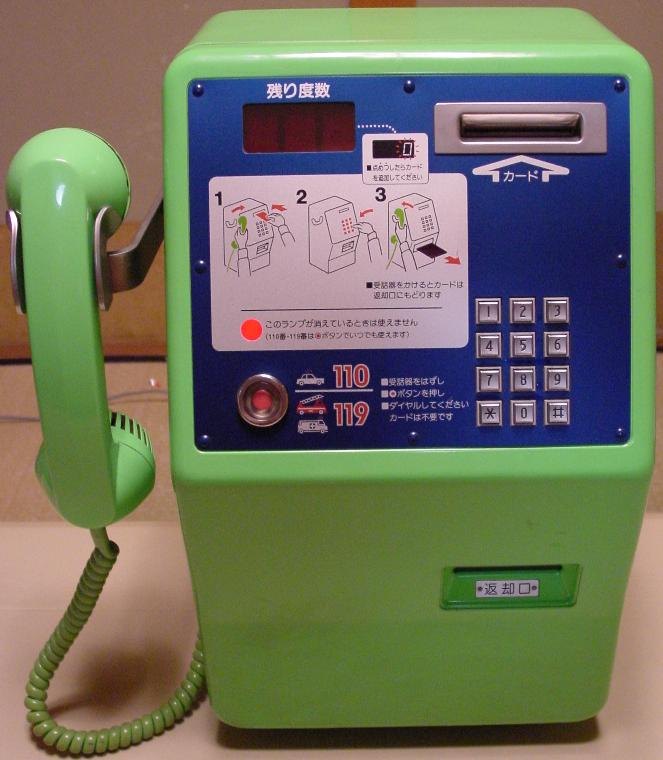
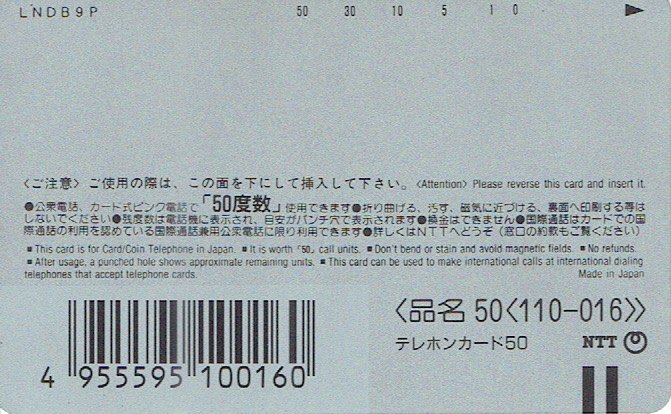
A green Japanese card payphone
The Green Payphone
The card's home: NTT's green public telephones, built to take the magnetic card instead of a stack of coins.
The back of a 50 unit NTT phone card, with barcode and degree markings
The Back of the Card
The working side: magnetic stripe, issuer markings, and the denomination printed as part of the card's identity.

THE ART SURFACE

A poster the size of a wallet
Custom Printing
NTT's free design program let organizations commission cards with their own artwork. Cards were made as advertising, as commemorative gifts, as event souvenirs, and even as business cards.
A Famous First Design
One of the designs issued at the format's birth was drawn by Taro Okamoto, among the most celebrated Japanese artists of the twentieth century. The art ambition was there from day one.
Printed for Occasions
Railway openings, expos, festivals, film releases, anime productions: if it happened in Japan between 1982 and the mobile phone era, there is very likely a card printed for it.
More from the Library →
MORE FROM THE PHONE CARDS ARCHIVE →
One shelf of eighty-two in the Library. Browse them all →

THE FIRST WORD

New pages and new pieces, first.