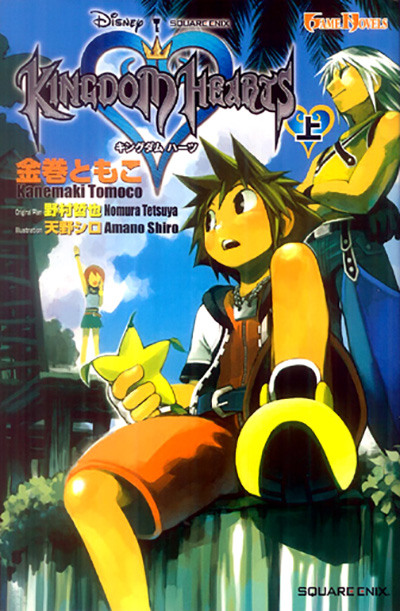
What are the Kingdom Hearts novels?
Alongside the manga, Square Enix publishes a full novel line for Kingdom Hearts, written by Tomoco Kanemaki and illustrated, covers and interiors, by the manga’s Shiro Amano. The credits frame the books’ authority: original plan by Tetsuya Nomura, with scenario supervision on key series from Kazushige Nojima, the games’ own scenario writer. The line began in 2005 with the first game in two volumes (June 30 and July 29) and proceeded game by game: Chain of Memories in three volumes (Sora’s story in two, Riku’s Reverse/Rebirth in the third), Kingdom Hearts II in four (2006–2007), 358/2 Days in three (2009–2010), Birth by Sleep in three (2010–2011), Re:coded in one (2011), Dream Drop Distance in two (from June 2012), and eventually Kingdom Hearts III in three volumes (2019–2020), more than twenty volumes in Japanese.
The novels matter to the series’ readers because of what prose can do that the games cannot. Kanemaki writes interiority: Organization XIII between missions, Axel’s calculations, Xion’s uncertainty, scenes the games stage as cutscenes retold from inside a single character’s head, alongside connective scenes the games only imply. The volume titles tell the story of that ambition: the Days trilogy ends with “Xion: Seven Days,” and the Kingdom Hearts II set closes on “Anthem: Meet Again / Axel Last Stand,” a novel built around a supporting character’s exit.
English readers waited a decade. The novels were Japan-only until Yen On, Yen Press’s prose imprint, began issuing them as omnibuses: Kingdom Hearts: The Novel in March 2015, the 600-page Chain of Memories volume that September, then Kingdom Hearts II across two omnibuses from 2017, with the 358/2 Days and Birth by Sleep sets following as single large volumes each. The English line remains the only official way to read Kanemaki outside Japanese, and it is the shelf where the manga’s artist and the novels’ author meet: Amano draws both.