
What did Metroid II add to the series?
Nearly everything the series is known for starts on the Game Boy: the silhouette, the saves, the life cycle, and the baby.
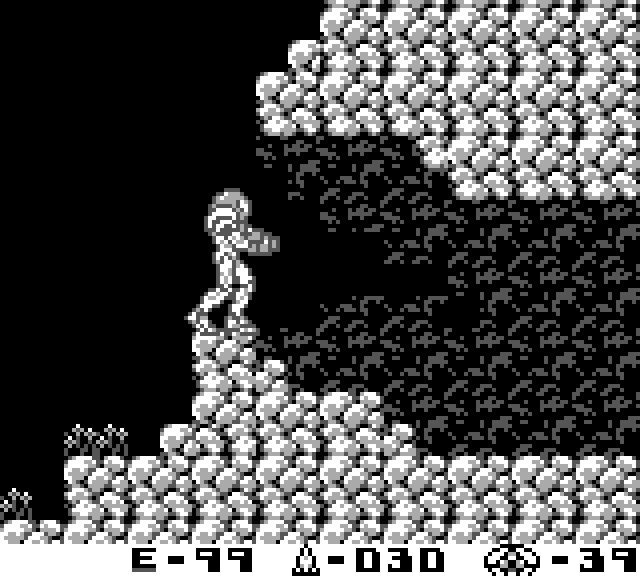
Metroid II: Return of Samus (1991) is the series’ quiet foundation stone. Sent to SR388 to exterminate the Metroids at their source, Samus works down through a planet of evolving horrors, and Nintendo used the smallest hardware it had to fix the series’ design language for good.
WHAT IT ADDED
The permanent giftsThe silhouette
The bulky Varia Suit, round shoulders and all, is standardised here. Samus has looked like this ever since, because a Game Boy sprite needed the read.
Battery saves
No passwords: a battery in the cartridge, save points on the planet, in every region. The series never went back.
The Spider Ball
Samus learns to grip walls and ceilings in ball form. The Spider Ball debuts here and becomes a series staple.
The life cycle
Metroids evolve on screen: Alpha, Gamma, Zeta, Omega, and at the bottom of the world, the Queen. II is where the creatures become a biology instead of a sprite.
THE ENDING
The babyThe hatchling
With the Queen dead, a last egg hatches in front of Samus, and the newborn Metroid imprints on her as its mother. She cannot shoot. She takes it with her, and hands it to Federation scientists: the single decision Super Metroid, and the whole saga, is built on.