What do the numbers on a Japanese phone card mean?
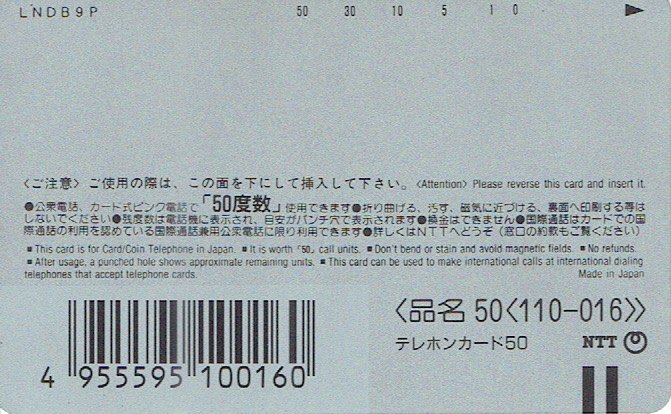
A phone card's denomination is printed as its degree count: the number of units loaded onto the card. At launch in 1982 the cards came in 50, 100, 300 and 500 units. One unit paid for ten yen of calls, and the payphone deducted the balance in one-unit steps as a call ran, so a 50 unit card was fifty small slices of talk time.
Three premium denominations followed: 105, 320 and 540 units. These were issued against round sums, with the extra units over the round number built in as a bonus, which is why their counts look odd next to the standard four. The two largest were withdrawn from use on December 28, 1991, after altered cards became a public problem; of the whole family, only the 50 and the 105 are still issued today.
The other numbers tell you the card's identity and its life. The issuer's name and the design's credits are printed on the face. And along the card's edge, the payphone punched a small hole for the units as they were spent: the holes are a progress bar you can read with your eyes, which is why an unspent card, no holes at all, can be told from a spent one at a glance.
READING A CARD
Face, back, and edge