
What happens in the Akira manga after the film’s story ends?
The film ends where the manga is only halfway home.
Spoiler note: this page maps the manga’s whole structure, including its ending. The Library’s companion page covers why the two endings differ; this one covers what the manga actually contains once the film’s material runs out.
The film adapts, roughly, the manga’s first three volumes and fragments beyond them, compressing as it goes. The structural shock of the manga is that its most film-like event, Akira waking and destroying Neo-Tokyo, is not the climax. It happens at the end of volume 3, the midpoint, and the manga then spends three full volumes in the ruins the film never shows.
THE SECOND HALF, VOLUME BY VOLUME
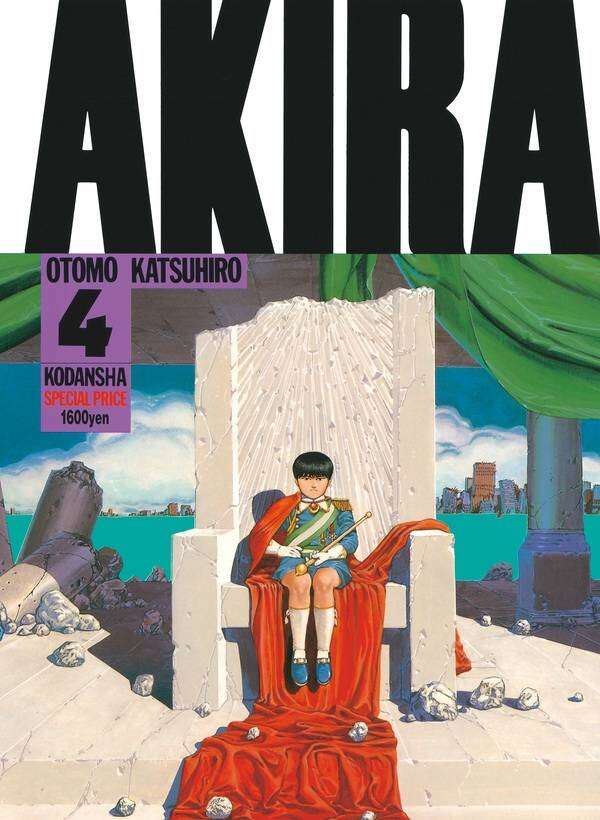
Empire, temple, and the world outsideVolume 4 · Kei I
Neo-Tokyo has split in two: Lady Miyako’s temple feeding and sheltering refugees, and the Great Tokyo Empire, where Tetsuo rules with the silent Akira as its god. An American reconnaissance team slips into the ruins to learn what happened, and Kaneda, swallowed by the blast, falls back out of the sky.
Volume 5 · Kei II
The world stops watching and starts boarding planes: an international team of scientists convenes on an aircraft carrier as Project Juvenile A, while a commando plot forms to kill Tetsuo and Akira with biological weapons. Tetsuo, his body beginning to transmute under its own power, tears a ring out of the Moon to demonstrate that he can.
Volume 6 · Kaneda
The bikers assault the stadium as the Americans escalate to carpet bombing and a laser satellite. Tetsuo’s power finally exceeds his body altogether, Akira answers it with a canceling explosion of his own, and the espers depart the world. Kaneda’s last act in the book is political, not martial: facing the arriving UN forces, he declares the ruined city a sovereign nation, and rides through streets that are beginning, impossibly, to restore themselves.
THE STRUCTURAL DIFFERENCE
A tragedy vs. a chronicleWhere the catastrophe sits
The film builds toward destruction as an ending. The manga puts destruction in the middle and asks the harder question after it: who governs the ruins, who feeds them, and what does the outside world owe them? Two-thirds of the manga’s architecture, occupation, empire, intervention, reconstruction, has no counterpart on screen at any length.
Why it feels like a different story
Because in structure it is one. Same cast, same city, same first half; then the film closes the book it had, and the manga keeps writing for three more volumes. The Library’s film page tells the production story of how that happened.