
What inspired Hajime no Ippo?
George Morikawa owns and runs a real Tokyo boxing gym and works his fighters' corners. Ippo is modelled on Mike Tyson and Ray Mancini. And the series exists because, after three cancelled manga, his editors talked him into challenging the one work he had called untouchable: Ashita no Joe.
The gym
JB Sports, Adachi-ku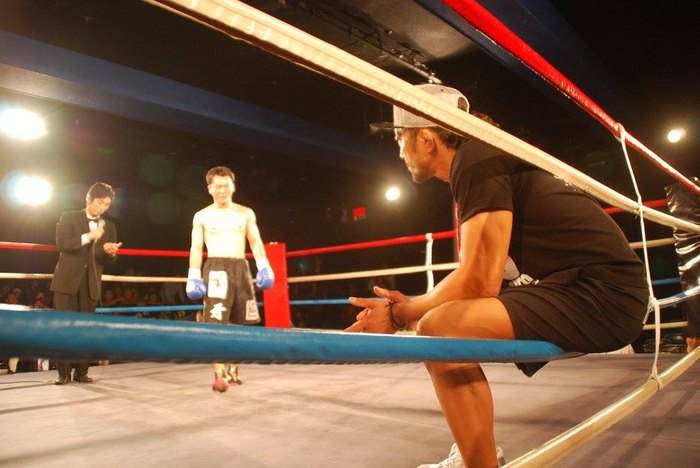
Morikawa is the owner and chairman of JB Sports Boxing Gym in Umejima, Adachi-ku, Tokyo. The gym's own site carries his chairman's message: 'Owner of JB Sports and author of Hajime no Ippo. When his fighters have a match, he works as their second and fires them up.' He holds a Japan Boxing Commission licence, and his gym has produced Japanese champions, including Manabu Fukushima in 2000 and Ryoichi Tamura in 2019. The popular version of the story, that he bought a gym with manga money, is not the documented one: under the previous chairman the gym ran at a deficit, Morikawa covered the shortfall from his own pocket, and he later took over management and turned it profitable.
The fighters
Tyson and ManciniIn the official 30th anniversary guidebook, Best Memorial, Morikawa names Ippo's models: Mike Tyson and Ray Mancini, both aggressive in-fighters, 'if I had to pick one, Ippo is more like Mancini,' who bobs and weaves his way in. In a published interview with Nonito Donaire he is blunter about the bullied boy at the story's start: 'That was based on Mike Tyson's childhood experiences.' Ippo's barefoot training came from something Joichiro Tatsuyoshi taught him. And his own gym's champion, Manabu Fukushima, is the name and model basis for Itagaki Manabu.
Ashita no Joe
The sanctuary he would not enterMorikawa became a manga artist because of Tetsuo Chiba: at about five years old he found Chiba's Harris no Kaze in a barbershop and decided that if he could not become the hero, he would become the person who created him. That reverence is why, after three cancelled series, he at first refused his editor Masahiro Nouchi's suggestion of a boxing manga. He did not want to challenge Ashita no Joe in the same magazine; he called boxing manga a sanctuary he should not invade. Nouchi persisted ('Because it is the last chance, let's compete in the genre you like best'), and the editor-in-chief then told him to change his high school amateur draft into a professional setting and challenge Chiba directly. The often-repeated claim that Morikawa set out to build a hero who wins through effort as the opposite of Joe is not a statement of his that this research could find; it is printed here as inference, not as his aim.
What is documented is the question at the series' core. After three cancellations Morikawa kept asking his idol, in his head, what it feels like to be good at making manga. He wrote the question down nearly as-is: 'What does it mean to be strong?' He never got to ask Chiba directly. Readers have been asking it with Ippo for over three decades.
The fishing boat
A correctionIppo's family runs a fishing boat business, and retellings often hand that biography to Morikawa. No source opened for this page supports it. What is documented: fishing is Morikawa's own passion, a day a week reserved for it, and the character modelled on Morikawa himself, gym manager Yagi, is pro-level at fishing and mahjong. The boat is fiction built from the author's love of fishing. The shy, bullied kid is Tyson-modelled, not Morikawa-modelled.