
What is An Omnipresence in Wired?
The 1999 artbook: 128 hardbound pages that hold most of ABe’s Lain, the Layer illustrations, the game art, and the only Lain manga ever made.
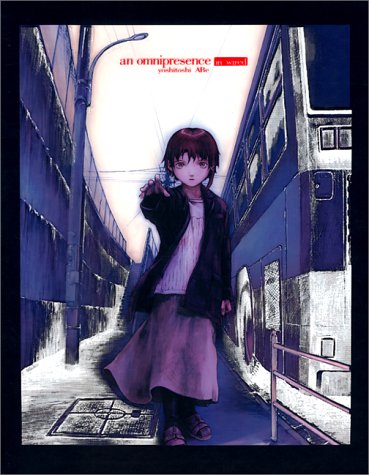
An Omnipresence in Wired, full title, yoshitoshi ABe lain illustrations: an omnipresence in wired, was published in Japan in 1999, hardbound, 128 pages. It is less a companion book than the project’s second body: ABe’s illustrations for every Layer of the anime, his concept sketches, a section of illustrations from the PlayStation game, and, bound in near the back, The Nightmare of Fabrication, the short color manga ABe drew as a dōjinshi. Some of the illustrations carry text by Chiaki J. Konaka, so the book reads in places like a conversation between the writer and the artist.
THE OBJECT ITSELF
How to recognize the 1999 editionThe vanishing cover
The first edition wears a transparent plastic slipcover printed with the title and white shading. Take it off and the book underneath has no title at all, only the picture of Lain. Few anime artbooks are this willing to disappear.
The original layers
The heart of the book is the run of illustrations ABe made for Sony Magazines’ AX magazine in 1998, one image per Layer, most of them overlaid with Japanese text by Konaka. They are the project’s visual script: the anime, told in thirteen stills.
ABe’s introduction
The book opens with ABe writing about his concept of Lain’s existence and how it manifested in his creative process, the closest thing the project has to a statement of intent from its artist.
THE 1998 PAPER TRAIL
The books that came before itVisual Experiments Lain (1998)
The production book, published by Triangle Staff and Pioneer LDC while the series aired: 80 full-color pages of creation, design, and storyline material (ISBN 978-4-7897-1342-9). Where Omnipresence is the art, this is the workshop, including the design sheet that shows Lain’s name written three ways.
Serial Experiments Lain Official Guide (1998)
MediaWorks’ companion to the PlayStation game, released alongside it in late 1998: the filing-system game’s paper key, and today a collecting item in its own right.
Then the artbook
Read in order, the three books trace the whole method: a workshop volume during broadcast, a guide for the game, and finally the artbook that treats the illustrations as the work itself.