
From the Library: covers, censuses, and editions, documented. Browse the Library →
SOJ Soul Blade · Vintage Fighting Games
← Back to the Fighting Games Gallery

What Is Edge Master Mode in Soul Blade?

A story mode that paid you in swords.

Arcade mode in Soul Blade gives you a ladder of fights and an ending. Edge Master Mode, added for the PlayStation version, gives you a journey. You pick one of the ten starting characters, their story is presented as the chapters of a book, and you travel a world map from location to location, fighting battles that often come with a rule attached. Win, and the chapter usually rewards you with a new weapon.

It is the reason the PlayStation version is remembered as more than a port, and it is the direct predecessor of the Weapon Master mode later used in Soulcalibur II.

HOW A RUN WORKS

Book, map, fights
The book
Each character's story is told in text chapters, with a reason given for every journey and every fight. The endings shown at the end of an Edge Master run are the endings from the arcade version of Soul Edge.
The map
You move between named locations on a world map, fighting in a set order, and you can return to earlier places. Every character starts in their own part of the world.
The final weapon
After you defeat SoulEdge and finish the ending, one last weapon remains. Returning to the map and letting the game choose your destination points you at it, and the weapon moves location when you lose, so the hunt continues until you win the right fight.

THE CONDITIONS

Fights with a rule attached
Timed fights
Many quests require defeating the enemy within a brief period of time, which changes which weapon you want in your hand.
Restricted damage
Some fights can only be won your way: using air combos to defeat the enemy is a recurring condition, and others start you on low life and ask you to survive the handicap.
Why the rules exist
The conditions are a training system in disguise. A mode that forces air combos, comebacks and speed wins teaches mechanics that plain ladder fights never require.

THE WEAPONS

Seven extra per character
Five statistics
The port added seven extra weapons per character, each with its own design and statistics: Power for damage dealt, Defense for damage received, Strength for damage to the enemy weapon gauge, Durability for resistance of your own gauge, and Weight, which changes your character's speed.
Special abilities
Certain weapons carry an ability on top of the numbers, such as damaging an opponent through their guard, or restoring or draining the wielder's health.
70 in total
Collecting is the long game. Obtaining all eight weapons for both Siegfried and Sophitia unlocks the alternate characters Siegfried! and Sophitia!, and obtaining all 70 weapons in Edge Master Mode unlocks Sophitia!!, a third version of Sophitia.

WHY IT MATTERED

The mode that outlived the game

Edge Master Mode solved the home fighting game's oldest problem: what a single player does after the ladder is memorised. Its answer, story chapters, condition fights and a collection of stat differentiated weapons that carry into the rest of the game, became a series fixture. Weapon Master in Soulcalibur II is its direct successor, with the main difference that weapons there are bought rather than only earned.

It also changed what a port was allowed to be. None of this existed in the arcade. Namco built it for the living room, and reviewers noticed: Electronic Gaming Monthly singled out the new story mode in its praise of the PlayStation version.

THE GAME ON THE SHELF

Soul Blade
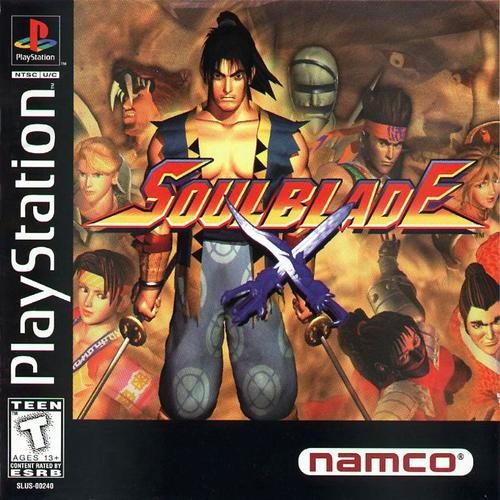
Soul Blade American PlayStation box art
Soul Blade · America · PlayStation
The American PlayStation box for the game whose Edge Master Mode this page explains.
More fighting games →

THE FIRST WORD

First word on new listings, plus a subscriber promo code for the eBay store.