
From the Library: covers, censuses, and editions, documented. Browse the Library →
SOJ The Lord of the Rings · The Oldest Game
← Back to the Library

What is the oldest Lord of the Rings video game?

The Hobbit, from 1982.

The oldest licensed Tolkien video game is The Hobbit, an illustrated text adventure developed by Beam Software and published by Melbourne House, released first for the ZX Spectrum in the UK in December 1982. It was converted to most home computers of the era: Commodore 64, BBC Micro, Amstrad CPC, Apple II, IBM PC, Mac, MSX, Oric and Dragon machines among them.

One honest distinction matters here. The Hobbit is a Tolkien game before it is strictly a Rings game: it adapts the 1937 novel The Hobbit, not The Lord of the Rings. The first game adapting The Lord of the Rings itself was Beam's follow-up, Lord of the Rings: Game One, in 1985. If the question means Middle-earth games as a whole, the answer is The Hobbit, 1982. If it means the Rings story itself, the answer is Game One, three years later.

What makes the 1982 game more than a trivia answer is how advanced it was. Its parser, its physics and its independent characters were doing things the form had not done before, and the game sold accordingly. The tiles below stick to what the record documents, including the sales figures, which are large without needing to be inflated.

Why it was ahead of its time

The parser, the physics, and characters with minds of their own
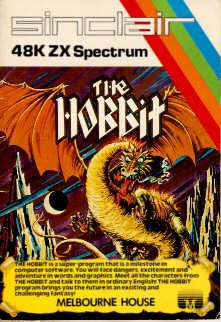
The Hobbit, 1982 ZX Spectrum cover, Melbourne House
The Hobbit, 1982
The ZX Spectrum cover. Beam Software developed the game and Melbourne House published it, first in the UK in December 1982.
Inglish, the parser
Most adventures of the day understood two word commands like "get lamp." Inglish, built by Philip Mitchell, handled full sentences, pronouns, adverbs, punctuation and prepositions. A documented example: "ask Gandalf about the curious map then take sword and kill troll with it."
Characters who act on their own
The non-player characters are bound by the same rules as the player, with loyalties, strengths and personalities. Gandalf roams the roughly fifty locations freely, picking up objects, fighting and getting captured, whether you are there to see it or not.
A real physics system
Veronika Megler built a text-based physics system in which objects and characters have size, weight and solidity. Objects can be put inside other objects or tied together with rope. Sit in a barrel, and if the barrel is thrown through a trapdoor, you go through too.
Pictures, drawn live
Many locations are illustrated, from originals designed by Kent Rees. On tape versions each image was stored as compressed outline information and flood filled on screen, which could take several seconds per picture on the hardware of the day.
Real time, and famously buggy
Idle for too long and the game invokes WAIT on its own: time passes and events happen without you. The documentation warned the game was too large and complex to guarantee it error free. Version 1.1 fixed some bugs and added one that made the game unwinnable, forcing a version 1.2.

How it sold, and what it started

A bestseller that launched a series
The sales, as documented
The Hobbit was a bestseller in the UK on the ZX Spectrum in 1983, and on Commodore 64 and BBC machines by the end of that year. The documented figures are over 100,000 copies in its first two years, at a retail price of £14.95, and over 500,000 units in Europe. Claims of a million copies are not what the record cited here supports, so this page does not use them.
The award and the book in the box
The game won the 1983 Golden Joystick Award for best strategy game. By arrangement with the book publishers, a copy of Tolkien's novel was included with each game sold. Beam had acquired the licence for the computer rights to The Hobbit back in 1980, and development took about eighteen months.
The lineage
Beam followed The Hobbit with Lord of the Rings: Game One in 1985, Shadows of Mordor in 1987 and The Crack of Doom in 1989, and reused the Inglish parser in Sherlock. One line from the game entered popular culture on its own: "Thorin sits down and starts singing about gold."
More from the Library →
MORE FROM THE LORD OF THE RINGS ARCHIVE →
One shelf of eighty-two in the Library. Browse them all →

THE FIRST WORD

New pages and new pieces, first.