
From the Library: covers, censuses, and editions, documented. Browse the Library →
SOJ The Lord of the Rings · The Census
← Back to the Library

What Lord of the Rings video games are there?

28 major releases, across more than 40 years.

The short answer is: a lot of them, for a very long time. Licensed Middle-earth games start in 1982, before most game genres existed, and the newest entry on this page is from 2025. This census lists 28 major releases: the major releases, honestly framed, not every mobile game, browser game, expansion pack or parody ever made. Wikipedia's full list runs much longer once those are counted.

The shape of the list was set by the licence, not by the story. For most of the film era there were two separate Middle-earths. Vivendi held the rights to adapt Tolkien's books, through Tolkien Enterprises. Electronic Arts held the rights to adapt the New Line Cinema films. That is why 2002 produced two unrelated Fellowship era games a few weeks apart, and why Vivendi's game could include Tom Bombadil while EA's could use nothing from the books that the films had cut.

The split healed in stages. In 2005 EA secured the book rights alongside the film rights. After EA's last game, Conquest in 2009, the licence passed to Warner Bros., whose decade brought the LEGO games and Monolith's Shadow series. Warner Bros. then lost the publishing rights in 2022, after Middle-earth Enterprises was sold to Embracer Group, and the newest games come from smaller publishers working licence by licence.

One warning the list itself gives: a familiar title does not always mean the same game. Some ports were completely different projects by different studios. Interplay's Vol. I is the clearest case, with a 1990 computer role-playing game and a wholly different 1994 Super Nintendo game sharing one name.

The text adventure years

1982 to 1989 · Melbourne House and Beam Software
The Hobbit, 1982
Beam Software, published by Melbourne House. ZX Spectrum, Commodore 64, BBC Micro, Apple II and most other home computers of the day. An illustrated text adventure of the 1937 novel, and the first licensed Tolkien video game.
Lord of the Rings: Game One, 1985
Beam Software, published by Melbourne House. Home computers including ZX Spectrum, Commodore 64 and Apple II. Also sold as The Fellowship of the Ring Software Adventure, it was the first game to adapt The Lord of the Rings itself.
Shadows of Mordor: Game Two of Lord of the Rings, 1987
Beam Software, published by Melbourne House. Home computers including ZX Spectrum, Commodore 64 and Apple II. Game Two in Beam's sequence, carrying the adventure on from Game One toward Mordor.
War in Middle Earth, 1988
Synergistic Software, published by Melbourne House, with Maelstrom Games on the 8-bit versions. Amiga, Atari ST, Apple IIGS, IBM PC, Spectrum, Commodore 64 and more. A real time strategy game that combined army level war with character level play.
The Crack of Doom, 1989
Beam Software, published by Addison-Wesley. Apple II, Commodore 64, Macintosh and IBM PC. The closing volume of Beam's adventure sequence, named for the Cracks of Doom in Mount Doom.

The Interplay RPGs

1990 to 1994 · one title, two very different games
J.R.R. Tolkien's The Lord of the Rings, Vol. I, 1990
Interplay Productions. MS-DOS first, then Amiga (ported by Silicon & Synapse), PC-98 and FM Towns. A large, open role-playing game of The Fellowship of the Ring, with side quests, recruitable companions and a day and night cycle.
J. R. R. Tolkien's Riders of Rohan, 1991
Beam Software and Papyrus Design Group, published by Konami and Mirrorsoft. MS-DOS only. A strategy simulation shrunk from the whole war down to Rohan, as the player holds the Rohirrim lands against Saruman.
J.R.R. Tolkien's The Lord of the Rings, Vol. II: The Two Towers, 1992
Interplay Productions. MS-DOS, PC-98 and FM Towns. The sequel splits into separate parties the way the book does, and opens at Fangorn. Its ending was saved for a Volume III that never came.
J.R.R. Tolkien's The Lord of the Rings, Vol. I, 1994
Interplay Productions. Super Nintendo only. Not a port: a completely different action role-playing game under the same title, ending at the Balrog in Moria and supporting multiplayer through the Super Multitap.

The rights split and the film era

2002 to 2006 · two licences, two Middle-earths
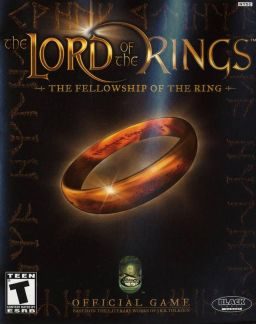
The Lord of the Rings: The Fellowship of the Ring, 2002 Black Label Games cover
The Fellowship of the Ring, 2002
Vivendi, under its Black Label Games label. PlayStation 2, Xbox, Windows and Game Boy Advance. Built only from the book licence, so it could use material the films cut, including Tom Bombadil, and nothing from the films at all.
The Two Towers, 2002
Electronic Arts, developed by Stormfront Studios. PlayStation 2, Xbox, GameCube and Game Boy Advance. The film licence answer to Fellowship: because EA made no Fellowship film game, this one covers the first two films together.
The Hobbit, 2003
Sierra Entertainment, a Vivendi company, developed by Inevitable Entertainment and others. GameCube, PlayStation 2, Xbox, Windows and Game Boy Advance. A younger skewing action adventure of the novel, with no connection to the film trilogy.
The Return of the King, 2003
Electronic Arts, developed by EA Redwood Shores. PlayStation 2, Xbox, GameCube, Windows and Game Boy Advance. The hack and slash finale to EA's film trilogy, following on directly from its Two Towers.
The Third Age, 2004
Electronic Arts, developed by EA Redwood Shores, with a separate Game Boy Advance version by Griptonite. PlayStation 2, Xbox and GameCube. A turn-based role-playing game that follows in the footsteps of the films with its own party.
The Battle for Middle-earth, 2004
Electronic Arts, developed by EA Los Angeles. Windows only. Real time strategy on a campaign scale, built from the film licence.
The Lord of the Rings: Tactics, 2005
Electronic Arts, developed by Amaze Entertainment. PlayStation Portable only. A tactical role-playing game, and the one major release made for a single handheld.
The Battle for Middle-earth II, 2006
Electronic Arts, developed by EA Los Angeles. Windows and Xbox 360. The first strategy sequel after EA secured the book rights as well in 2005, so film designs and book lore could finally appear in the same game.

The online and Warner Bros. years

2007 to 2017 · an MMO, LEGO, and the Shadow games
The Lord of the Rings Online, 2007
Developed by Turbine. Windows, later Mac. Launched on April 24, 2007 as Shadows of Angmar, a massively multiplayer game under the book licence, opening in Eriador and then expanding for years through Moria, Rohan, Gondor and Mordor.
The Lord of the Rings: Conquest, 2009
Electronic Arts, developed by Pandemic Studios. PlayStation 3, Xbox 360, Windows and Nintendo DS. Large battle action in the style of Pandemic's Battlefront games. It was EA's last Middle-earth game, and the licence then passed to Warner Bros.
Aragorn's Quest, 2010
Warner Bros. Interactive Entertainment, developed by Headstrong Games on Wii and TT Fusion elsewhere. Wii, PlayStation 3, PlayStation 2, PSP and Nintendo DS. The first Warner Bros. release: Sam tells his children the story of Aragorn, with motion control swordplay on Wii and PlayStation 3.
War in the North, 2011
Warner Bros. Interactive Entertainment, developed by Snowblind Studios. PlayStation 3, Xbox 360 and Windows. A cooperative action role-playing game set in the northern war, and the first of the decade's M rated Middle-earth games.
LEGO The Lord of the Rings, 2012
Warner Bros. Interactive Entertainment, developed by Traveller's Tales. Windows, PlayStation 3, Xbox 360, Wii and handhelds. The whole film trilogy retold in LEGO, voices and all.
LEGO The Hobbit, 2014
Warner Bros. Interactive Entertainment, developed by Traveller's Tales. Windows, PlayStation 3 and 4, Xbox 360 and One, Wii U and handhelds. It adapts the first two Hobbit films, An Unexpected Journey and The Desolation of Smaug.
Middle-earth: Shadow of Mordor, 2014
Warner Bros. Interactive Entertainment, developed by Monolith Productions. PlayStation 4, Xbox One and Windows, with PlayStation 3 and Xbox 360 versions as well. An original story set between The Hobbit and The Lord of the Rings: the ranger Talion, bound to the wraith of Celebrimbor, and the Nemesis system that made enemies remember you.
Middle-earth: Shadow of War, 2017
Warner Bros. Interactive Entertainment, developed by Monolith Productions. PlayStation 4, Xbox One and Windows. The sequel: Talion and Celebrimbor forge a new Ring and raise an army of their own against Sauron.

The new wave

2023 to 2025 · after Warner Bros.
The Lord of the Rings: Gollum, 2023
Daedalic Entertainment, published with Nacon. Windows, PlayStation 4 and 5, Xbox One and Series X/S. A stealth adventure played entirely as Gollum, released on May 25, 2023 to generally negative reviews.
The Lord of the Rings: Return to Moria, 2023
Free Range Games, published by North Beach Games. Windows, PlayStation 5 and Xbox Series X/S. A survival crafting game set in the Fourth Age, as a company of dwarves reclaims Moria and works to restore Khazad-dum. First released October 24, 2023.
Tales of the Shire, 2025
Developed by Weta Workshop, published by Private Division. Windows, PlayStation 5, Xbox Series X/S and Nintendo Switch. A non-violent, cozy life game about hobbit life in the Shire, released July 29, 2025.

The one that never shipped

Cancelled · The White Council

The most notable absence on this page is The Lord of the Rings: The White Council, an open world role-playing game from EA Redwood Shores, announced in 2006 for PlayStation 3, Xbox 360 and PC. Players would have created a Man, Dwarf, Elf or Hobbit and earned a place as an ally of the White Council. On February 2, 2007, EA put the game on indefinite hiatus, and nothing further was ever released. EA made Conquest with Pandemic Studios instead.

More from the Library →
MORE FROM THE LORD OF THE RINGS ARCHIVE →
One shelf of eighty-two in the Library. Browse them all →

THE FIRST WORD

New pages and new pieces, first.