
From the Library: covers, censuses, and editions, documented. Browse the Library →
SOJ Fist of the North Star · The Writer
← Back to the Library

Who is Buronson?

A radar mechanic who escaped poverty into the Air Self-Defense Force, and came out with the wasteland in his head.

Buronson is the best-known pen name of Yoshiyuki Okamura, born June 16, 1947, in Saku, Nagano. After junior high school he entered the Japan Air Self-Defense Force to escape poverty, graduated in 1967 and served as a radar mechanic. There he befriended Hiroshi Motomiya; after leaving the service he joined Motomiya’s studio as an assistant in 1971 and made his writing debut in Weekly Shōnen Jump in 1972. The name came from the studio: after watching Adieu l’ami, his colleagues decided he resembled its star, Charles Bronson, and the nickname, mustache and all, became his byline. (He also writes as Sho Fumimura.)

His first success was the hardboiled detective manga Doberman Deka (1975 to 1979) with Shinji Hiramatsu. In 1983 Jump assigned him to write for a young artist named Tetsuo Hara, whose pilot stories he liked but whose modern setting he rejected: the post-apocalyptic future was Buronson’s call, informed by Mad Max and by a trip he had taken to Cambodia, where the fallen Khmer Rouge regime’s killing fields shaped how he wrote his characters and their dialogue.

After Hokuto no Ken he wrote, among much else, Sanctuary and the award-winning Heat with Ryoichi Ikegami. He later founded a manga school in his hometown, the Buronson 100-Hour Manga School in Saku (2018). In his late seventies he was still, by his own account, walking new stories into publishers’ offices and being turned down, and submitting them anyway.
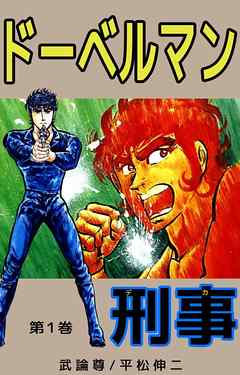
Cover of Doberman Deka volume 1, story by Buronson, art by Shinji Hiramatsu
BURONSON'S FIRST HITDoberman Deka (1975–79), written by Buronson with art by Shinji Hiramatsu — the police hit that made his name before Hokuto no Ken.

THE CAREER, IN BRIEF

1972 to today
1972 · Debut
First published work as a writer in Weekly Shōnen Jump, after two years assisting Hiroshi Motomiya, the encounter that set his life’s direction.
1975–79 · Doberman Deka
The hardboiled police serial with Shinji Hiramatsu that made his name for tough, cinematic storytelling.
1983–88 · Hokuto no Ken
Five years, 245 chapters, with Tetsuo Hara. The writer-artist pair seldom met during the run; editor Nobuhiko Horie carried scripts between them, which both men later said sharpened the work.
As Sho Fumimura
His second byline, used across the same decades for other publishers and genres, including the Self-Defense Force manga Phantom Burai drawn from his own service years.

WHY THE WRITING SOUNDS LIKE THAT

Two documented sources
Cambodia
Visiting after Pol Pot’s fall, Buronson saw human remains piled where a society had been. He has said it influenced both his characters and the dialogue, the speeches about death and dignity that the series is quoted by.
The cinema of hard men
Bruce Lee’s films and Charles Bronson’s screen presence stand behind the series’ laconic heroics as surely as they stand behind its author’s name.
More from the Library
MORE FROM THE FIST OF THE NORTH STAR ARCHIVE →
One shelf of the Library. Browse them all →

THE FIRST WORD

New pages and new pieces, first.