
From the Library: covers, censuses, and editions, documented. Browse the Library →
SOJ Marvel vs. Capcom · Vintage Fighting Games
← Back to the Fighting Games Gallery

Why Couldn't the PlayStation Marvel vs. Capcom Do Tag Teams?

It could not hold four fighters at once. That is the whole answer.

In the arcade, Marvel vs. Capcom is a tag team game: each player picks two fighters and can swap between them at any point, so a match needs four complete characters loaded at the same time, each with hundreds of hand drawn animation frames, plus a randomly assigned Special Partner waiting to be summoned.

The PlayStation could not do that. Capcom said so at the time in effect, reviewers documented the result in detail, and the port that shipped in 1999 and 2000 is built entirely around the workaround. Here is the arithmetic.

THE TWO COVERS

Same game, two shelves
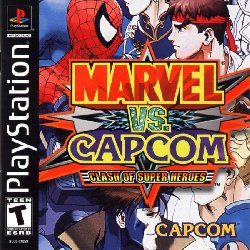
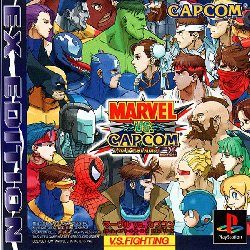
Marvel vs. Capcom PlayStation US box art
United States
Spider-Man and Ryu carry the American cover, the two faces of the crossover.
Marvel vs. Capcom PlayStation Japanese box art
Japan · EX Edition
Japan renamed the port the EX Edition and packed the cover with the full cast.

THE MEMORY PROBLEM

Documented, piece by piece
The PlayStation budget
The original PlayStation has 2 MB of main RAM and 1 MB of video RAM. Every fighter sprite, animation frame, background, sound sample and line of game code in a match has to live inside that budget, loaded from CD.
The arcade ask
A tag match holds four full fighters in memory simultaneously, so either partner can enter instantly without a loading pause. GameSpot’s contemporary review states the result plainly: the arcade and Dreamcast supplied a four fighter tag team battle, while the PlayStation’s RAM limitation limits the battle to two fighters.
What Capcom chose to protect
Capcom removed tag team battles due to the console’s limited RAM capacity in an attempt to preserve the main game’s speed and graphical integrity. Speed and looks were kept. The defining mechanic was the price.
The frames went too
Many frames of animation were also omitted as a result of insufficient RAM, particularly in larger character sprites. Big characters such as Hulk and Onslaught lost the most, because their sprites cost the most memory per frame.
What the partner became
In most modes the second character you select is reduced to an assist role, similar to the guest characters: it appears for short special attacks and team super combos, but it never tags in and never fights a round of its own. Capcom added the ability to link multiple super combos to compensate for the lost tag action.
The one exception
A single mode, Cross Over, restores real tagging by forcing both players to use identical teams, so only two unique fighters ever need to be in memory. It is covered on its own page in this wing.

THE CONTRAST THAT PROVES IT

Same game, more memory, no cuts

The Dreamcast version of the same game, released months earlier in 1999, keeps full tag team play and was praised as a flawless, arcade perfect translation. Nothing about the game design changed between the ports. The hardware budget did, and the feature list followed it exactly.

Reviewers noticed immediately. GameSpot scored the PlayStation version 5.8 out of 10 against 9 out of 10 for the Dreamcast version, and Jeff Gerstmann’s verdict has become the standard summary of the port: it has the same moves as the original game, but the shell surrounding those moves is completely different. GamePro took the other side of the same fact, praising Capcom for cutting features rather than overloading the system. Both reviews agree on the cause: memory.

More fighting games →

THE FIRST WORD

First word on new listings, plus a subscriber promo code for the eBay store.