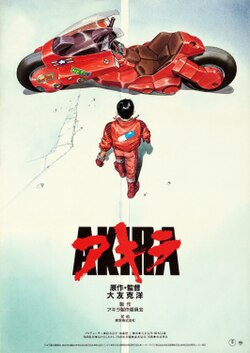
Why did Akira open the West to anime?
Japanese animation had reached Western screens long before 1988. Television series such as Astro Boy and Speed Racer were hits in the United States in the 1960s, but they were received by the general public as children's cartoons, and thought of as more American than Japanese. What had never crossed over was an animated film for adults: violent, political, formally ambitious and unmistakably Japanese. Akira was that film, and the record of its Western life can be dated step by step.
At home first: released by Toho on July 16, 1988, it was the sixth highest grossing Japanese film of its year, earning 750 million yen in distributor rentals in 1988. In America, Streamline Pictures gave the English version a limited theatrical release on December 25, 1989; it grossed about $2.2 million in the United States, a modest sum that understates what happened next. In the United Kingdom, Island Visual Arts opened it on January 25, 1991: it debuted at number three at the UK box office, stayed in the top ten for four weeks, and had grossed 878,695 pounds by early March 1991.
Theatres introduced it; home video made it a phenomenon. The Streamline dub reached VHS in May 1991, with wider Orion Home Video distribution from September 1993, including the original Japanese version with English subtitles. The Criterion Collection's 1992 LaserDisc was that company's first animated release. By 1993 the film had sold 60,000 tapes in the United Kingdom, 100,000 in Europe and 100,000 in the United States, and the documented consequence of the UK release's success was institutional: it led to the creation of Manga Entertainment, the distributor that carried anime into British shops for a generation. By 2014 the film had earned more than $80 million worldwide in home video sales.
The larger claims exist, and this page prints them as what they are: criticism, attributed. The British Film Institute's programme notes call it "impossible to overestimate how key Akira was in bringing anime to a wider Western audience" and describe the film as having "almost single-handedly introduced this form of animation to worldwide audiences". Michelle Le Blanc and Colin Odell, whose BFI Film Classics volume on the film opens with the line "Without Akira there would be no 'Cool Japan'", are cited by the BFI calling it a major catalyst for the West's ongoing obsession with cool Japan. Dan Persons of Cinefantastique listed it in 2004 among the ten essential animations as, simply, "the film that changed everything". The standard summary in the reference record is narrower and more careful: a landmark film that led the way for the growth of anime and Japanese popular culture in the Western world, and a forerunner of the second wave of anime fandom that began in the early 1990s.
One honest limit belongs on the page. The film did not travel alone: the manga arrived in English the same year the film opened in Japan, in Marvel's Epic Comics edition of 1988, and comics historian Paul Gravett's account concludes that film and comic reinforced each other's success and worked together as ambassadors for Japanese popular culture. The door, in other words, was opened by a film and a comic arriving together, each proving the other was not an accident.
THE WESTERN RECORD, DATED
Theatres first, then the video shelfTHE POSTER
Akira, 1988