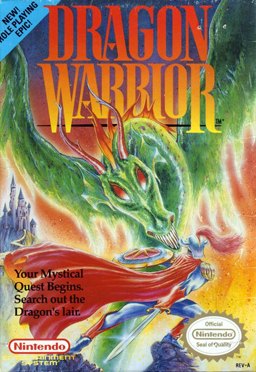
Why did Dragon Quest lose its Akira Toriyama art in America?
In Japan, Toriyama's art was the point. Yuji Horii, who knew the artist through Weekly Shonen Jump, commissioned him precisely so the game would stand apart from every other role-playing game: the slime's grin, the hero's silhouette, the whole visual identity of Dragon Quest is Toriyama's hand. Japanese players bought the art as much as the game.
The American edition, arriving in August 1989, was packaged as something else. The game was renamed Dragon Warrior, because the tabletop role-playing game DragonQuest (Simulation Publications, 1980) already held the name, and the box dropped Toriyama's work for a painted knight confronting a dragon in the manner of Western fantasy novels and Ultima's covers, the visual language American RPG buyers were presumed to trust. The pattern held through the NES sequels and the Game Boy Color era. Series historian Daniel Andreyev, in The Legend of Dragon Quest, sums the Western covers up as having absolutely nothing in common with Toriyama's design.
No single surviving memo says 'hide the manga artist,' and this page does not invent one: the documented record is the covers themselves and the idiom they follow. What can be dated is the ending. Square Enix registered the Dragon Quest trademark in the United States in 2002, and in 2005, Dragon Quest VIII shipped in America under its real name with Toriyama's art on the box. The art had not changed. America's idea of what an RPG could look like had.
THE AMERICAN BOX
Dragon Warrior, 1989