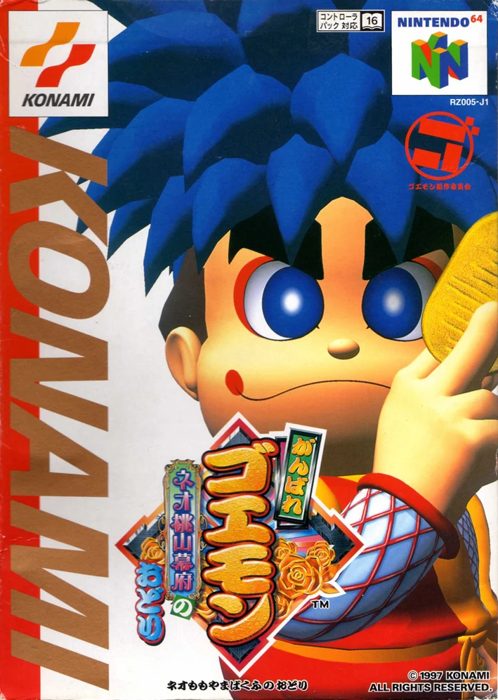
Why did most Goemon games never leave Japan?
The size of the thing first. The Ganbare Goemon series began in arcades with Mr. Goemon in May 1986 and ran through Famicom, Super Famicom, PlayStation, Nintendo 64, Game Boy Color, and PlayStation 2 to a final original entry on the Nintendo DS in 2005: 23 games in the main series, plus board-game, puzzle, and futuristic spin-offs. Exactly five crossed the Pacific in any form: The Legend of the Mystical Ninja for the Super NES, Mystical Ninja Starring Goemon and Goemon's Great Adventure for the Nintendo 64, and two Game Boy titles, one of which reached Europe only, inside a Konami collection cartridge. Everything else, entire Super Famicom sequels, PlayStation entries, the 2005 DS finale, stayed home.
The reasoning was stated on the record. In July 1996, Next Generation reported Konami's position that the Goemon games were too specific to the Japanese market for worldwide release, and the one big Western test of the theory showed why the company believed it. When Mystical Ninja Starring Goemon did cross over in 1998, its localization became the story: Nintendo Power called the translation poor and the story nonsensical, GamePro found the untranslated battle cries alienating, while GameSpot and IGN maintained the localization was exemplary and the content was simply too specifically Japanese to be relatable or understandable to the average non-Japanese gamer. The games are dense with folklore, kabuki, period in-jokes, and puns that assume a Japanese childhood. Even the sales split agreed with the verdict: the N64 game sold 141,000 copies in Japan against 55,000 in America.
So the series lived where it was loved. After 2005 there were no new original games, and Goemon's likeness went to work in Konami's pachislot machines, appearing in the West mainly as a guest, a Mii costume in Super Smash Bros. Ultimate among the sightings. The story may not be finished: a compilation of the series' Famicom, Super Famicom, and Game Boy library, Ganbare Goemon! Daishūgō, has been announced for 2026. Whether it travels is the same question the series has asked for forty years.
THE COUNT
Verified from the series' own gameographyTHE GAME ON THE SHELF
Mystical Ninja Starring Goemon