
Why did the Japanese Famicom look different from the NES?
Japan's Family Computer, designed by Masayuki Uemura and released on July 15, 1983 at 14,800 yen, is a toy and proud of it: red, white and gold (Uemura's account credits a DX Antenna billboard in the colors of President Yamauchi's favorite scarf), cartridges standing upright in bright colors, controllers hardwired into pockets on the machine's sides, a microphone in the second controller, and a cartridge eject lever that Gunpei Yokoi suggested adding, in Uemura's telling, to amuse children.
America got a different machine because America had just buried the games business. After the 1983 crash, retailers refused to stock anything that read as a video game console. Nintendo of America's Lance Barr and Don James first answered with the AVS, a sleek computer-styled system shown in January 1985 to a lukewarm response. The machine that shipped was their second answer: the Nintendo Entertainment System, with a front-loading slot modeled on a VCR, two-tone gray panels, detachable controllers, and a name that avoided the word game entirely. Barr's early prototype was nicknamed, by the team, the lunchbox.
The disguise worked. The NES test-launched in New York on October 18, 1985, dressed as an entertainment appliance, and the American market let it in.
THE TWO MACHINES
Same silicon, two argumentsFamicom vs NES
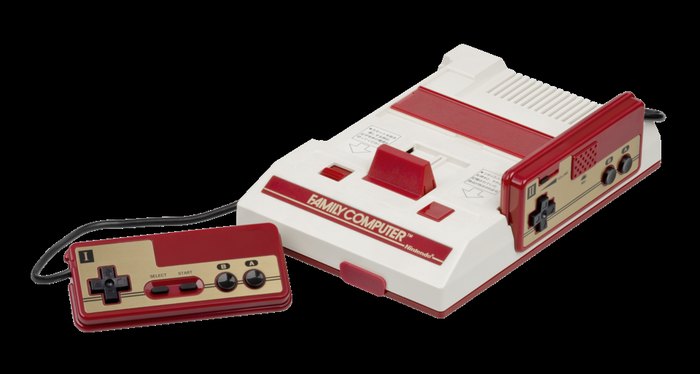
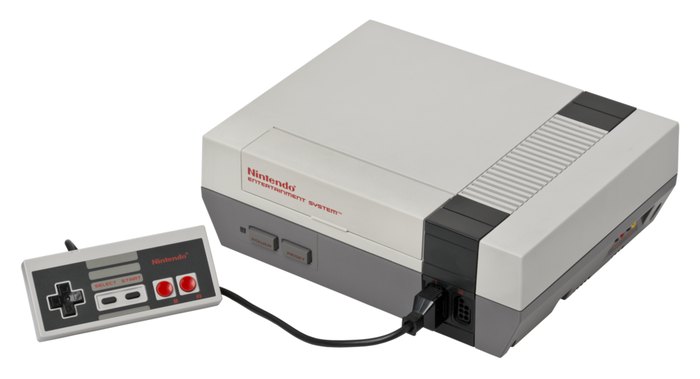
Under the plastic the two machines are the same computer. Everything that differs, the colors, the slot, the controllers, the name, is an argument about who the machine was for and what the shopper was willing to be seen buying.