Why do people collect Japanese phone cards?
The collecting started while the cards were still money. Collector clubs formed across Japan during the format's life, and the Teleca Collecting Association in Tokyo ran monthly swap meets in Ikebukuro where collectors traded designs face to face. Printed catalogs and specialist magazines catalogued the designs, because there were far too many for anyone to track alone.
What draws people is the compression. A phone card gives a designer one small rectangle, room enough for a logo, and the whole of an event or a series to say something about. Issued for premieres, anniversaries, railway openings and local festivals, the cards stack up into a timeline of Japanese popular culture, printed at the time, by the people who were there.
And the supply of stories is finite. The card was a creature of the payphone era; when the phones emptied out of daily life, the great run of designs ended with them. What survives is the printed record, card by card.
THE HOBBY, WHILE IT WAS CURRENT
Swap meets and catalogsWAYS PEOPLE COLLECT
By theme, by series, by placeTHE CARD
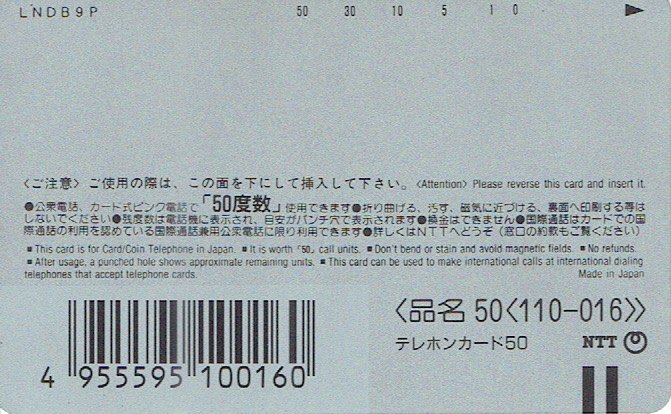
A 50 unit NTT card