From the Library: covers, censuses, and editions, documented. Browse the Library →
SOJ Phone Cards · Teleca
← Back to the Library

Why do people grade Japanese phone cards?

Because the object is a paper-thin piece of print, and for an object like that, condition and authenticity are the whole story.

A phone card is not built to survive. It is a sliver of printed plastic meant to live in a wallet, slide through a payphone slot, and be thrown away when the units ran out. The designs people care about are separated from damage by almost nothing: the surface scratches, the corners bend, the print fades in light, and the magnetic stripe on the back takes every knock the wallet delivers.

Grading answers three questions about an object like that. Is it genuine? Forgery was a genuine social problem in the card's own era, when altered magnetic stripes were enough of a plague that two denominations were withdrawn from use entirely, so authentication is not ceremony. Which design is it, exactly? Thousands of designs share characters and series; a holder's label records the issuer, the design and the denomination as a fixed identity. What state is it in, and can it stay that way? A sealed holder keeps the card flat, untouchable and out of the light, with its unspent or spent state, readable from the punch holes, preserved as found.

It is the same logic that puts a watercolor in a frame. The picture is the object. Grading is how the picture gets a fixed identity, a verified surface, and a case that treats it like one.

THE THREE QUESTIONS

Authenticate, identify, preserve
Is It Genuine?
In the card's own lifetime, faked and altered cards were enough of a social problem that the 320 and 540 unit denominations were withdrawn from use in 1991. A graded card's authenticity is examined, not assumed.
Which One Is It?
Designs repeat across years, events and issuers. The label fixes the card's identity: issuer, design, denomination, and its spent or unspent state, so the object can be catalogued without handling it.
Can It Stay This Way?
The holder is a flat, sealed, light-shielding case sized to the card. The thin printed surface that wallets and payphone slots used to destroy is held out of circulation permanently.

THE OBJECT ITSELF

Why thin print needs defending
The Surface Is the Art
On a phone card there is no depth to fall back on: the printed face is the entire work. A scratch is not wear on a container, it is damage to the picture itself.
The Punch Holes Are History
A spent card's holes record its life in the phones. Preserved as found, they are part of the object's story; the holder keeps that record legible instead of letting it blur with handling.
Flat Is a Condition
Thin cards curl, warp and crease in drawers and albums. Held flat under even pressure, the card keeps the shape it was printed with.

THE CARD

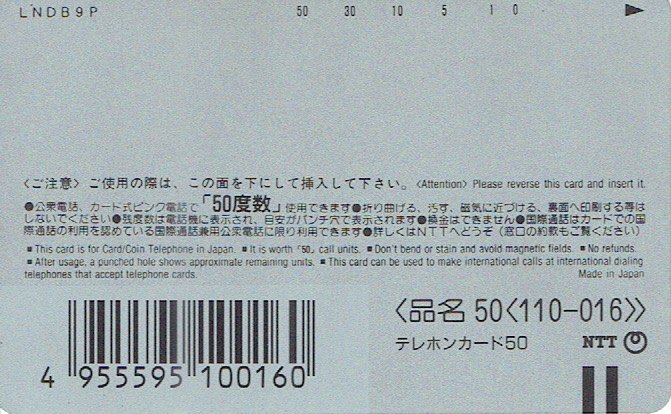
A 50 unit NTT card
The back of a 50 unit NTT phone card, with barcode and degree markings
NTT phone card · Back · 50 units
The back of a 50 unit NTT phone card. Grading, the subject here, turns on the condition of cards exactly like this one.
More from the Library →
MORE FROM THE PHONE CARDS ARCHIVE →
One shelf of eighty-two in the Library. Browse them all →

THE FIRST WORD

New pages and new pieces, first.