
Why was the PC Engine called the TurboGrafx-16 in America?
The witness is Ken Wirt, vice president and general manager of NEC's American TurboGrafx-16 group, interviewed by Nintendo Life. Before launch, NEC tested the Japanese name on American customers. "We found that the name 'PC Engine' caused quite a bit of confusion," Wirt said. "In the US 'PC Engine' was literally interpreted by customers as 'Personal Computer Engine'." A name that sounded like imported flair in Tokyo sounded like office equipment in Ohio.
The replacement was picked the same way, by testing. "The name change came about because we tested a number of different options and the one that did the best was the one that described the main benefit of the product, which was the graphics. Hence the name: TurboGrafx-16." The 16, Wirt confirms, pointed at the machine's 16-bit graphics chips. The CPU at the system's heart is an 8-bit part, which is why the name drew charges of creative accounting then and teasing now.
The box got the same treatment as the badge. The PC Engine, at fourteen centimeters square the smallest major home console ever sold, was rebuilt into a large black American casing, because, per Wirt, testers asked why something so expensive came in such a small package. The machine launched in Japan on October 30, 1987 and in America on August 29, 1989, and only America renamed it: Europe kept PC Engine.
THE TWO BODIES
Smallest console, biggest renamePC Engine vs TurboGrafx-16
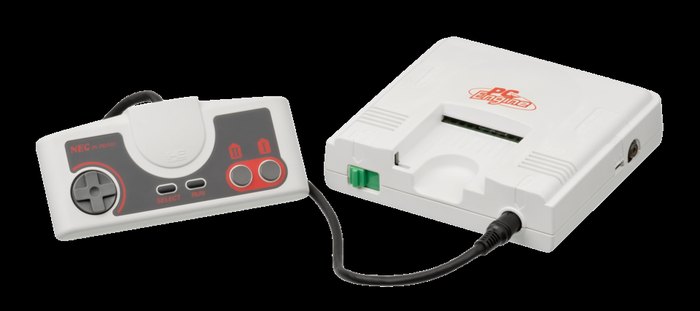
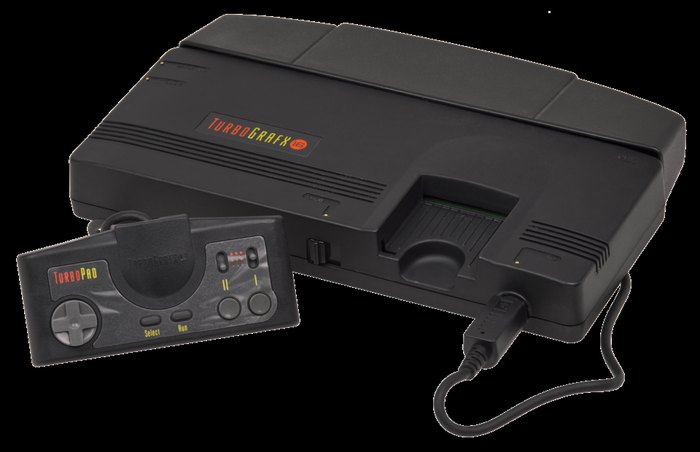
Name, shell and marketing all say the same sentence: this is not a toy computer peripheral, it is a powerful graphics machine. NEC's American arm rewrote everything except the games.