From the Library: covers, censuses, and editions, documented. Browse the Library →
SOJ Famicom ยท Nintendo's First Machine
← Back to the Library

Why were some Famicom games on floppy disks?

Because in 1986 the cartridge was the most expensive way to ship a game, and the disk fixed nearly everything about that, including the save file.

Start with the chip shortage. Cartridges were built from semiconductor memory that was scarce and costly in mid-1980s Japan, and it showed in the shops: cartridge games sold for 5,000 to 7,000 yen, in limited runs that sold out. A Disk Card was stamped plastic and magnetic film. Disk games sold under 3,000 yen, could be manufactured quickly, and in 1986 a disk's roughly 112 kilobytes was more room than most cartridges offered.

Rewritability changed the games themselves. A disk could be written to, so progress could be saved onto the disk instead of transcribed as a password. It also changed the business: with Disk Writer kiosks, Nintendo could sell the same physical disk again with a different game on it, and the format added an extra sound channel that composers used immediately.

The same openness ended it. Media that any kiosk could rewrite was media that anyone could copy, and piracy spread; margins on disks were thin, retailers cooled on the bulky kiosks, and by 1989 larger, cheaper cartridges had erased the disk's advantages. Nintendo let the format go, and the Disk System became a Japan-only chapter: nearly four million drives, and a generation of games that began life on floppy disks.

THE FOUR REASONS

Cost, capacity, saves, sound
Cost
Pressed plastic against scarce silicon: disk games launched under 3,000 yen while cartridges ran 5,000 to 7,000, and disks could be produced fast when a game took off.
Capacity
About 112 kilobytes across two sides beat the typical cartridge of 1986, room that launch titles like Zelda used for a bigger world.
Saving
A writable disk holds a save file. Passwords, the cartridge era's workaround, became unnecessary where the disk reached.

THE FALLOUT

Rewritable cuts both ways
Piracy
The feature was the flaw. Kiosks proved disks could be rewritten anywhere; unauthorized copying followed the same path, and Nintendo's control of its media slipped.
Thin Margins
Cheap games and a kiosk network cost money to run. Retailers soured on the floor space the big Writer kiosks demanded.
The Catch-Up
By 1989 cartridge memory was bigger and cheaper, and the disk's reasons were gone. The format stayed in Japan, and its games were rebuilt as cartridges for the West.

THE DISK

Famicom Disk System
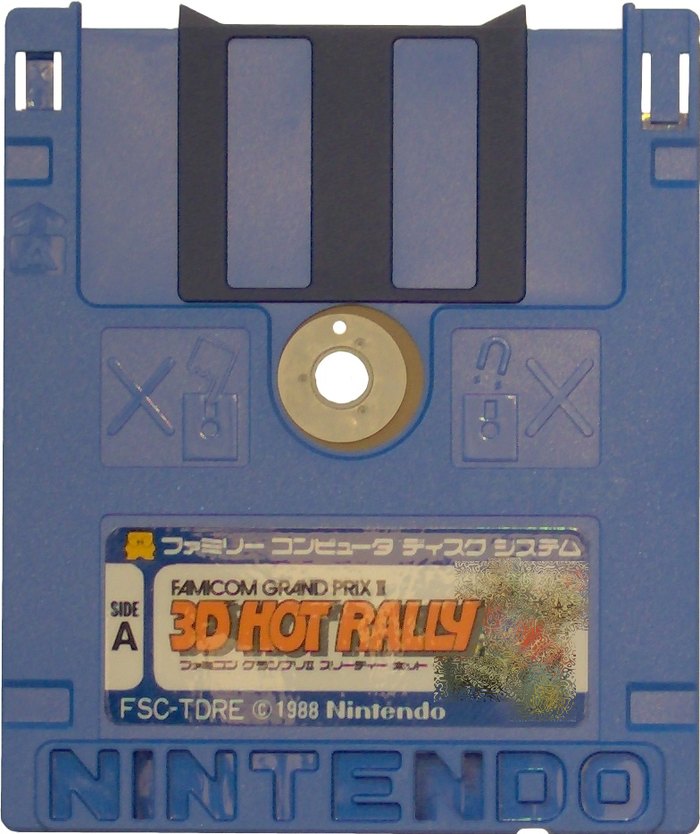
A Famicom Disk Card
Famicom Disk Card
A Famicom Disk Card, the floppy format itself: cheaper than a cartridge, writable, and the subject of this page.
More from the Library →
MORE FROM THE FAMICOM ARCHIVE →
One shelf of eighty-two in the Library. Browse them all →

THE FIRST WORD

New pages and new pieces, first.