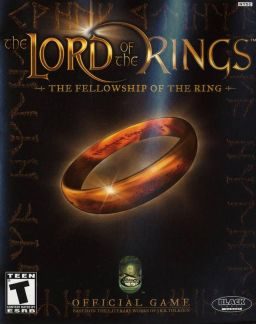
Why were there two different Fellowship games in 2002?
Vivendi had the books. Vivendi Universal Games, in partnership with Tolkien Enterprises, held the rights to video game adaptations of Tolkien's literary works. Its game, The Lord of the Rings: The Fellowship of the Ring, was published under the Black Label Games label and released in September and October 2002 for Xbox, Game Boy Advance, PlayStation 2, and Windows. WXP developed the Xbox version, Surreal Software the PlayStation 2 and Windows versions, and Pocket Studios the Game Boy Advance version. It adapts the 1954 novel, not the movie.
That is why Tom Bombadil is in it. Because the source was the book, Vivendi's game could include material Peter Jackson's films cut entirely. Its plot follows Frodo through the Old Forest, where Tom Bombadil rescues the hobbits from Old Man Willow, takes them to his house and his wife Goldberry, and saves them again from a Barrow-wight in the Barrow-downs. None of that could appear in an EA film game.
EA had the films, and no Fellowship film game. Electronic Arts held the rights to video game adaptations of the New Line Cinema films. As both games' articles put it, EA chose not to publish a game based on Jackson's Fellowship film, and instead incorporated some of its plot and footage into The Two Towers (2002), developed by Stormfront Studios and released a few weeks after Vivendi's game. The Two Towers therefore adapts two films at once: the 2001 Fellowship film and the 2002 Two Towers film, opening at Weathertop and retelling the first film's story on the way to Helm's Deep.
So the duplication was not a race to copy an idea. It was a rights map made visible on store shelves: one publisher legally owned the novel on a disc, the other legally owned the movies on a disc, and in the biggest movie season of the year, both shipped.
THE RIGHTS MAP
Who could show whatTHE 2002 SCOREBOARD
Two games, one seasonONE OF THE TWO
The Fellowship of the Ring, 2002