
Rave Master, Fairy Tail, Edens Zero: One Universe
Three series, one toolbox, characters who keep being reborn.
Hiro Mashima's three long serials were all published in Weekly Shōnen Magazine, and they behave like rooms in one house. Rave Master (1999–2005) came first, Fairy Tail (2006–2017) second, Edens Zero (2018–2024) third, and the furniture moves with him: Plue serves in both Rave and Fairy Tail, a version of Happy the cat reports for duty in Edens Zero, and each hero carries a season in his name.
This is not a shared continuity in the superhero sense. It is something rarer and more honest: one artist visibly reusing and refining his own inventions for twenty-five years, then, twice, drawing the formal crossovers himself.
THREE SERIES, ONE WORKSHOP
Rave Master · Fairy Tail · Edens ZeroRave Master, 1999–2005
The first serial: Haru Glory, the Rave Master, travelling the world to gather the Rave Stones. 35 volumes, and the seedbed of everything after: Plue, the trembling dog-like creature with a carrot nose, appears here first.
Fairy Tail, 2006–2017
The second serial keeps Plue, now a Celestial Spirit, and rebuilds the travelling party as a guild. The world changed from a journey to a home the heroes return to, which is the structural difference between the two series.
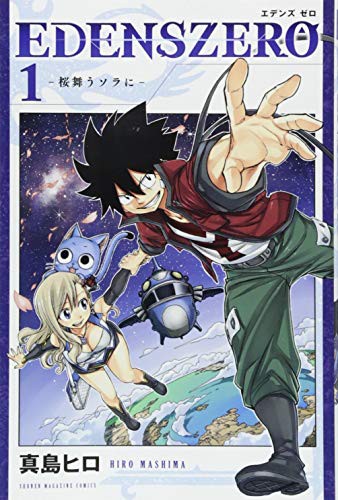
Edens Zero, 2018–2024
The third serial takes the workshop to space: 33 volumes, 293 chapters. A Happy who is a robot, faces that recall earlier heroines in new roles, and the seasonal naming carried on in Shiki Granbell.
The crossover in print, 2011
Mashima crossed his first two series himself: a Fairy Tail × Rave one-shot ran in Weekly Shōnen Magazine in 2011, and was adapted into an original anime DVD in August 2013.
Mashima Hero's, 2019
For the magazine's 60th anniversary Mashima drew the three worlds together properly: Mashima Hero's, a miniseries running October to December 2019, gathered in one volume. Kodansha's English edition bills it as the ultimate crossover of his universe.
Why it reads as one universe
Shared creatures, recycled character designs refinished for new roles, the same seasonal names, the same party-of-friends architecture. Mashima does not hide the joins; the recycling is the signature.