
The Jugdral Games
Jugdral is the continent of Kaga's Super Famicom diptych, held in the same world as Archanea at a great distance of time and sea. Genealogy of the Holy War (1996) is the series at its most ambitious; Thracia 776 (1999) is a midquel set inside Genealogy's own second half. Neither has ever been officially released in English.
THE TWO GAMES
A diptych, 1996 and 1999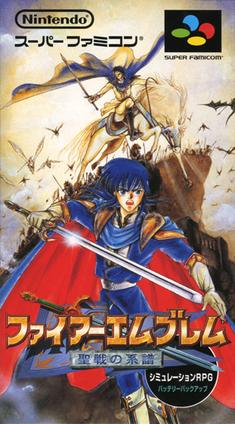
WHAT JUGDRAL INVENTED
Systems the series still lives onGenealogy is the series' great laboratory. It introduced the weapon triangle and the trinity of magic, the series' rock-paper-scissors grammar, documented on the design shelf of this archive. It introduced skills carried in the blood, repair shops that made legendary weapons permanent possessions instead of consumables, and the love system: pairings chosen by the player produce the second generation's soldiers, who inherit their parents' skills, growths, and holy weapons. Awakening's marriage and children, two decades later, are this system revived.
The scale is the other invention. Genealogy's chapters are whole countries on single maps, with castles to seize in sequence and armies marching in real time across a continent. No later game has maps that large, and the structure makes the politics literal: you watch borders move.
THE HARDER BROTHER
Thracia, on its own termsThracia 776 narrows the lens from a continent to a peninsula and from princes to refugees, and it is deliberately unforgiving: a capture mechanic for taking enemy equipment, fatigue that benches overused soldiers, fog, rain, and rescue rules that punish carelessness. It is Kaga's final Fire Emblem and widely held to be the series' most demanding game, a parting statement about what the genre could ask of a player. Its distribution was an experiment too: a flagship strategy game delivered by convenience-store flash cart before it was ever a box on a shelf.