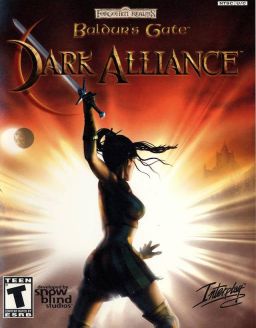
The History of Baldur's Gate: Dark Alliance
A note on placement before the history: Baldur's Gate: Dark Alliance is a multiplatform game, and it was a PlayStation 2 game first, released there in December 2001, reaching the Xbox in October 2002 alongside a GameCube version. It sits in this Xbox era gallery because the approved roster places the Xbox RPG era's story here, and because the Xbox version is a real part of that era. Nothing on this page or in the gallery implies it was an Xbox exclusive, because it was not.
What it was: the first Baldur's Gate on consoles, a real time action RPG built from the ground up by Snowblind Studios, and the origin of the engine that would power a whole shelf of PlayStation 2 and Xbox co-op dungeon crawlers, including Champions of Norrath, whose history in this Library covers the engine's second career. This page covers the first.
THE MAKING
Snowblind gets the call after a Dreamcast port diesDark Alliance was first revealed in November 2000, when Interplay confirmed to IGN that a PlayStation 2 game based on Baldur's Gate II had entered production, following the cancellation of the Sega Dreamcast port of the original Baldur's Gate. BioWare, the PC series' developer, would not make it. Snowblind Studios would, with Black Isle Studios publishing under Interplay, Darren Monahan producing, and design shared by Chris Avellone, Ezra Dreisbach, and Ryan Geithman. Jeremy Soule and Will Loconto composed.
Snowblind director Ryan Geithman's statement at the February 2001 confirmation is the project's charter, on the record: the game was developed from the ground up to take full advantage of the PlayStation 2, to push the hardware to its limits with environmental effects and detailed characters not seen on the console before. Black Isle's Feargus Urquhart framed the bet: the studio recognized the huge demand for a Baldur's Gate game on PlayStation 2. The Xbox version followed the PS2 original by about ten months, substantially the same game, a point its reviewers made plainly, as the reception below records.
THE DESIGN AND THE ENGINE
Three heroes, one screen, and a new engine under everythingThe PC series' pauseable party tactics became a real time, rotatable 3D hack and slash: three preset heroes, the dwarven fighter Kromlech, the human archer Vahn, and the elven sorceress Adrianna, each with distinct feats and spells, experience spent on levels and abilities, and two player cooperative play on one shared screen, the kill splitting experience 60 to 40. The rules underneath were Dungeons and Dragons 3rd Edition, released in 2000, and Dark Alliance was the first video game to apply those rules in real time.
The technology was the headline. Snowblind built a new engine, the Dark Alliance engine, for the game: fully 3D characters and environments with dynamic lighting and real time shadowing, a generational jump from the Infinity Engine's 2D sprites and static backdrops. IGN's PS2 review called it one of the best 3D engines yet devised. That engine's reuse, in this game's sequel, in Fallout: Brotherhood of Steel, in The Bard's Tale, and most famously in Champions of Norrath, is covered in the Norrath history; the short version is that this game is where the era's co-op dungeon house style was invented.
THE EDITIONS
The versions that existTHE RECEPTION
The scores, with the dissent keptTHE LEGACY
The engine's first career, told once, hereDark Alliance's legacy divides cleanly. The game itself proved a famous PC RPG name could be reinvented, not merely ported, for consoles, and it started the console Baldur's Gate line that continued in Dark Alliance II. The engine beneath it had the longer career: Snowblind's technology became the foundation for the co-op action RPGs that defined the genre on two consoles, and Sony Online Entertainment hired Snowblind off this game to give EverQuest the same treatment in Champions of Norrath.
This Library tells that engine story across two pages to avoid telling it twice: the invention here, the second career in the Champions of Norrath history on the PS2 shelf. The Xbox version's own modest place in that story is recorded above without decoration: late, unchanged, and still well reviewed, a good port of a PS2 landmark.
THE GAME ON THE SHELF
Dark Alliance · 2001