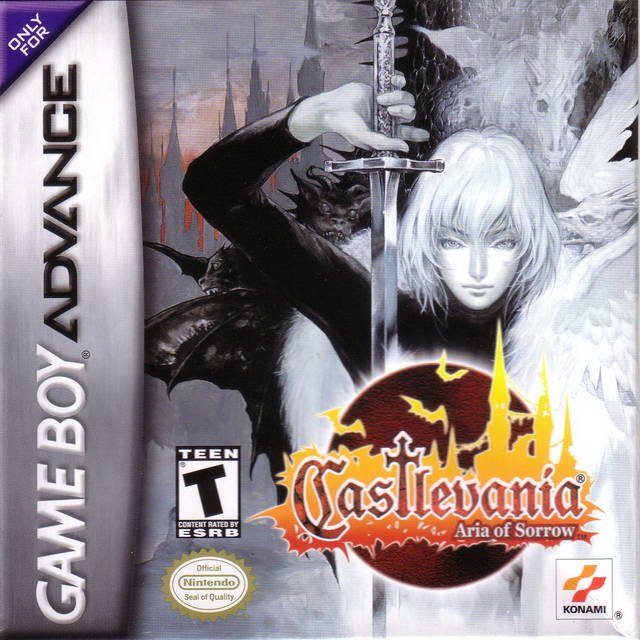
The History of Castlevania: Aria of Sorrow
In 1999, Julius Belmont destroyed Dracula completely and sealed his castle inside a solar eclipse. In 2035, exchange student Soma Cruz visits the Hakuba shrine with his friend Mina to watch that eclipse, and wakes inside the castle, absorbing the souls of its monsters. Castlevania: Aria of Sorrow (Game Boy Advance, May 2003), Akatsuki no Menuetto in Japan, is the third and last Castlevania on the system, and by several measures its best reviewed handheld entry.
THE MAKING
Igarashi's different route, 2002 to 2003Koji Igarashi produced, with Junichi Murakami, new to the series, directing and Shutaro Iida programming. The game was produced in parallel with Harmony of Dissonance, sharing its engine and much of its grammar, while Igarashi said he wanted to try a "different route" for the series: a future setting, with Ayami Kojima dressing the cast in contemporary clothes instead of medieval costume. The back story is partly his construction from prophecy: Nostradamus's prediction of a great evil lord in 1999 and the real 1999 solar eclipse over Eastern Europe.
Aria is also a documented act of self-correction. Harmony of Dissonance's music had been criticized, so Michiru Yamane, Symphony of the Night's composer, was hired, and the team deliberately gave the audio more cartridge space and processor time while protecting Harmony's visual quality. Features Harmony had dropped, hidden rooms and breakable walls, were put back. Even the collecting was designed socially: souls can be traded between two cartridges over a link cable, because Igarashi believed completing the set alone would be too difficult.
THE DESIGN
The Tactical Soul systemNearly every enemy in the castle can yield its soul, and souls are equipment: Bullet souls in red replace sub-weapons, Guardian souls in blue grant continuing powers such as transformations and familiars, Enchant souls in yellow raise statistics or grant abilities like walking on water, and the rare Ability souls, won from one-of-a-kind enemies, stay active for free. The system turns the bestiary into an inventory and gives a linear castle a collector's second game inside it.
The structure around it is the Symphony model matured on a handheld: experience and levels, a shop run by a soldier named Hammer who abandoned his mission to open it, and a full New Game Plus, the first complete implementation in the series, alongside Hard mode, a Boss Rush, and Julius Mode, which hands the castle to the Belmont who ended Dracula. Three endings turn on which souls Soma carries into the fight with the missionary Graham Jones, who believes the inheritance is his.
THE EDITIONS
One game, a shelf of versionsTHE RECEPTION
Acclaim, with the dissent keptGameSpot's reservations were about weight: a single run lasts about ten hours, the player grows "practically unstoppable," and the music, while far better than Harmony's, was judged mostly forgettable. IGN praised the plot's departure from formula and still called the ending "incredibly unfulfilling and disappointing." GameSpy's summary represents the majority: it "managed to get just about everything right." The commercial split is the strangest number on this page: the game sold 27,000 copies in Japan in its first month, a poor showing, and over 158,000 in the United States in three months. The series' homeland shrugged at its future; America bought it.
THE LEGACY
A system too good for one gameIgarashi said the Tactical Soul system and Soma's story were, in his words, a waste to use in only one game, and the result was Dawn of Sorrow (2005), a rare direct sequel in this series. The sequel also records the cost of the sales split: because Aria's figures failed to meet expectations, Dawn dropped Kojima's art for an anime style aimed at a younger handheld audience, a trade the Library's art page documents.
What survived is the standing of the original. Aria is routinely named the definitive Game Boy Advance Castlevania, the portable entry measured against Symphony of the Night rather than excused by its hardware, and its producer's other ambition, a game about Julius Belmont's 1999 battle, remained a stated desire dependent on production time: the most important Castlevania story has still never been a game.
THE GAME ON THE SHELF
Aria of Sorrow · GBA