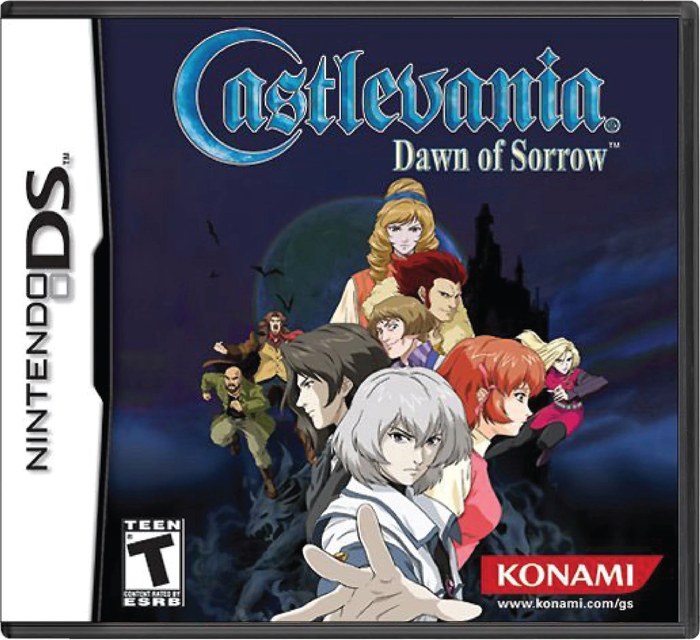
The History of Castlevania: Dawn of Sorrow
In 2036, a year after Soma Cruz learned he is Dracula's reincarnation and refused the inheritance, the cult leader Celia Fortner sets out to manufacture a new dark lord, by killing Soma if necessary. Castlevania: Dawn of Sorrow (Nintendo DS, 2005), Akumajo Dracula: Sougetsu no Juujika in Japan, is the direct sequel to Aria of Sorrow and the first Castlevania on the Nintendo DS.
THE MAKING
Why the DS, and why a sequelAnnounced on January 6, 2005, and produced by Koji Igarashi with Satoshi Kushibuchi directing and much of the Aria team returning, the game went to the DS rather than the PSP because of Aria's success on Nintendo's Game Boy Advance. Igarashi's own reason for a sequel is on this Library's Aria page: the Soma story and the Tactical Soul system felt like a waste to use in only one game.
The Tactical Soul system returns in full, Bullet, Guardian, Enchant, and Ability souls, now with souls also spent at Yoko's shop to forge weapons into stronger forms, and a Julius Mode that hands the castle to Julius, Yoko, and Alucard on the assumption that Soma fell. The DS hardware added the Magic Seal: after a boss falls, the player draws a pattern on the touch screen to finish it, or the boss recovers and the fight resumes. Igarashi has said the touch features were a launch era pressure, and that he worried they would slow the pure action down.
The art decision is documented and was contested from the start. Ayami Kojima did not design this game's characters; the cast was drawn in an anime style aimed at the younger audience Igarashi believed the DS attracted, after Aria's sales missed expectations. Michiru Yamane and Masahiko Kimura composed.
THE EDITIONS
One game, a shelf of versionsTHE RECEPTION
Acclaim, with the dissent keptThe reservations were consistent: GameSpot timed a run at about five hours and found the game fairly easy for the series; the Magic Seal drawing was criticized as a gimmick that forced a stylus grab mid fight; and the anime portraits drew the sharpest words, GameSpy calling them shallow and lifeless next to Kojima's work. Sales ran the Aria pattern in reverse proportion: over 15,000 in its first week in Japan and 164,000 in the United States in three months. The game was later included in the book 1001 Video Games You Must Play Before You Die.
THE LEGACY
The DS trilogy beginsDawn set the pattern for three DS games in four years and proved the Symphony model had a second home. Its systems, souls, forging, and the unlockable trio mode, all carried forward, and its 2024 return in the Dominus Collection, with the seals reworked, closed the portability question that had kept the DS trilogy off modern shelves for two decades.
THE GAME ON THE SHELF
Dawn of Sorrow · DS