The History of Castlevania III: Dracula's Curse
The year is 1476, three centuries before Simon. The Belmonts have been exiled from Wallachia, and with Dracula's army ravaging Europe, the church calls them back. Castlevania III: Dracula's Curse (Japan: Akumajo Densetsu, December 22, 1989; North America, 1990) returned to the first game's platforming, then widened it: branching routes, four playable characters, and the debut of Alucard.
THE MAKING
Konami, 1989, and a chip the West never heardHitoshi Akamatsu directed his third Castlevania in a row. The game's most consequential fact is a piece of silicon. The Japanese cartridge carries Konami's VRC6 coprocessor chip, which the game's audio programmer Hidenori Maezawa helped create. The chip added two pulse channels and a saw wave channel to the Famicom's five sound channels, and the score combines them to imitate a synthesized string section.
Western hardware could not follow. The NES had no ability to support external sound chips, so the American release substituted Nintendo's MMC5 mapper and the music had to be rewritten by Yoshinori Sasaki for the standard five channels. The Japanese version is, measurably, a richer sounding game, and the difference is documented hardware, not nostalgia. The versions differ in play as well: in Japan, Grant throws his daggers rather than stabbing, several enemies deal less damage, and backgrounds and effects differ across many stages, while the North American and PAL versions hide name-entry features, including starting with ten lives under the name "HELP ME," that Japan never received.
THE DESIGN
Two roads to the castle, three companionsDracula's Curse keeps sixteen stages but refuses to line them up. After the opening, the road forks repeatedly: an upper route across the lake and through the castle's front gate, a lower route through tunnels and caverns and up the cliff face, nine or ten stages per road, converging in the main hall. Endings change with the road taken and the company kept.
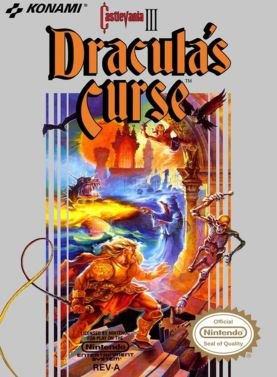
Trevor can recruit exactly one companion: Sypha Belnades, whose elemental magic is strong where her body is frail; Grant Danasty, the pirate who climbs walls and ceilings and changes direction in mid-jump; and Alucard, Dracula's own son, who shoots fireballs and turns into a bat. America answered Japan's ensemble box painting with its own: Tom duBois painted the North American cover and said he was inspired by the films of Ray Harryhausen, a debt the Library's art page examines.
THE EDITIONS
One game, a shelf of versionsTHE RECEPTION
Acclaim, with the dissent keptThe standing criticism, in its own era and since, is the difficulty: Famitsu's reviewers named it the game's main drawback even while praising everything else. The insider verdict is warmer than the public one. Former producer Koji Igarashi cites Dracula's Curse as his favorite game in the series, for its sound and setting, and Shutaro Iida, who programmed the Game Boy Advance entries, says the same, citing the Japanese version's special sound chip specifically. The chip, again: the people who make these games can hear the gap too.
THE LEGACY
The prequel that became a series, twiceDracula's Curse is the rare prequel that outgrew its frame. Netflix built the first two seasons of its animated Castlevania series (2017) on this game's story, Trevor, Sypha, Grant, and Alucard against Dracula, and its storyline continues in the games Curse of Darkness (2005) and Belmont's Curse (2026).
Its deepest legacy walks on two legs. Alucard, recruited here as a supporting character, returned eight years later as the protagonist of Symphony of the Night, carrying this game's ensemble idea into the series' most famous entry.
THE GAME ON THE SHELF
Dracula's Curse · NES