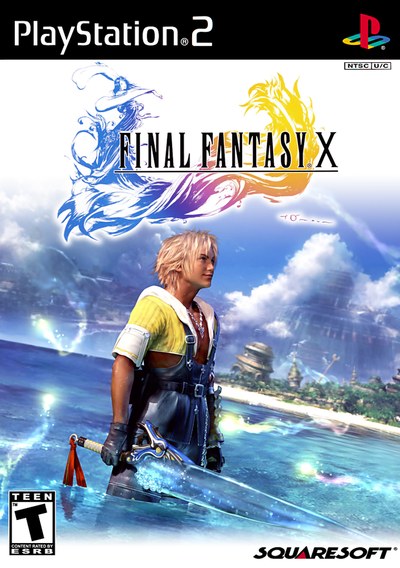
The History of Final Fantasy X
Final Fantasy X (PlayStation 2, 2001) was the series stepping onto new hardware and changing its grammar at the same time: fully three dimensional areas instead of pre-rendered backdrops, spoken dialogue instead of text boxes, and a battle system that stopped the clock instead of racing it. It shipped over 8.5 million copies on the PlayStation 2 alone and became the first game in the series to earn a direct sequel.
THE MAKING
Square, 1999 to 2001Development began in 1999 inside Square Product Development Division 1, with a budget of about 4 billion yen (roughly US$32.3 million) and a crew of more than 100 people, most of them veterans of the earlier games. Yoshinori Kitase produced and directed; Kazushige Nojima led the scenario writing, working with Daisuke Watanabe and Motomu Toriyama, and the longer script process was driven by a new problem: the characters were going to speak out loud.
It was also the first main game not scored by Nobuo Uematsu alone. Uematsu composed alongside Masashi Hamauzu and Junya Nakano. Series creator Hironobu Sakaguchi admitted his doubts about the move to 3D backgrounds, voice acting, and real time storytelling, and answered them with the series' own habit: its success, he said, came from constantly challenging the team to try new things. An online component was planned early and dropped; online play arrived in the series with the next game instead.
THE DESIGN
Spira, the Sphere Grid, and a clock that waitsCharacter designer Tetsuya Nomura identified the South Pacific, Thailand, and Japan as the major influences on Spira, and the world follows through: tropical islands, water, and ritual, a deliberate break from the series' European style fantasy. The pilgrimage structure replaces the world map with one long road, so the player is always moving forward through the story.
The Conditional Turn-Based Battle system replaced the Active Time Battle clock the series had used since 1991: turns pause while the player decides, and a timeline shows how each action reshuffles who acts next. Party members can be swapped in mid battle. Growth runs through the Sphere Grid, a board of linked nodes that Kitase said was meant to let players watch their characters' development happen firsthand, and which can bend any character away from their intended role. Summons, called Aeons, no longer visit for a single attack: they take the party's place and fight. And over everything sits blitzball, the underwater sport Tidus plays professionally, introduced in the opening as Sin attacks his city.
THE EDITIONS
One game, then the first direct sequelTHE RECEPTION
Acclaim, and one long argumentCommercially there was nothing to argue about. Square expected at least two million copies on a young console; Japan alone pre-ordered about 1.4 to 1.5 million, more than 2.14 million units shipped on day one, and the game became the first PlayStation 2 title to pass both two million and four million copies sold. Japan bought 2.43 million copies in 2001 alone.
THE LEGACY
The template the HD era keptFinal Fantasy X set the pattern the series still lives with: voiced, cinematic, linear storytelling on hardware spectacle, with the systems depth moved inside the growth board. Its ending also broke the series' oldest rule, that each numbered game closes its own world, and the audience rewarded the break.
The remaster program kept it in print on every modern platform, and the X shelf passed 21.1 million copies by March 2022. On this Library's PS2 shelf it stands as the era's opening statement: the first game of the bench, and the one the rest were measured against.
THE GAME ON THE SHELF
Final Fantasy X · PS2