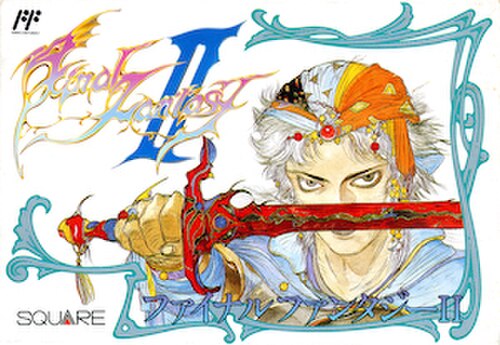
The History of Final Fantasy II
Final Fantasy II reached the Famicom on December 17, 1988, and then did something no other game in this gallery did: it stayed in Japan. No NES version was ever released. The West first played it in 2003, fifteen years later. What waited was the series' strangest experiment, a game with no experience points at all, and the debut of two of its most beloved fixtures.
THE MAKING
A small team, a bigger budget, and a trip to SacramentoThe first game's success let Square manufacture more copies and fund a sequel, and the returning staff, still only around ten people, chose difference as the brief. Sakaguchi directed, Kawazu co-designed, Gebelli programmed, Amano drew, Terada wrote, Uematsu composed. Kawazu later felt the team went too far in making the game different from the original, a judgment the design section below will earn.
Production took an unusual detour: Gebelli's work visa expired mid development, and rather than replace their programmer, the team packed the equipment, followed him to Sacramento, California, and finished the game there. They would do it again for the third game.
THE DESIGN
Stats that grow by being used, and a story with an empire in itExperience points are gone. In their place, Kawazu built a usage based growth system: swing a sword and sword skill, strength, and accuracy grow; take heavy damage and maximum hit points rise; spend magic points and the pool deepens. The system had a famous unintended consequence. Nothing in it required the enemy to be dangerous, or even to be the enemy, so players discovered they could attack their own party members and heal them, endlessly, and grow strong on self inflicted wounds.
Around the system sits the series' first real story: named heroes, Firion, Maria, Guy, and the lost brother Leon, fighting the Palamecian Empire in a rebellion the team built with The Empire Strikes Back as its stated inspiration. The game also added the Word Memory system, keywords learned in one conversation and spent in another, the back row in battle, and two arrivals that never left the series: the chocobo, designed by Ishii from a chicken he had kept as a childhood pet, and Cid.
THE EDITIONS
The versions, documentedTHE RECEPTION
Scores, sales, and the dissentBoth verdicts are about the same design. Final Fantasy II asked what an RPG would look like if characters grew the way people do, by doing, and players have been arguing about the answer ever since.
THE LEGACY
What it left behindThe main series voted with its feet: Final Fantasy III reverted to the original system after negative feedback. But Kawazu kept his invention, and carried it into his own SaGa series, starting with Makai Toushi SaGa for the Game Boy in 1989, where usage based growth became a franchise signature. The chocobo and Cid, meanwhile, became permanent: a character named Cid has appeared in every main series game since.
THE GAME ON THE SHELF
Final Fantasy II · Famicom