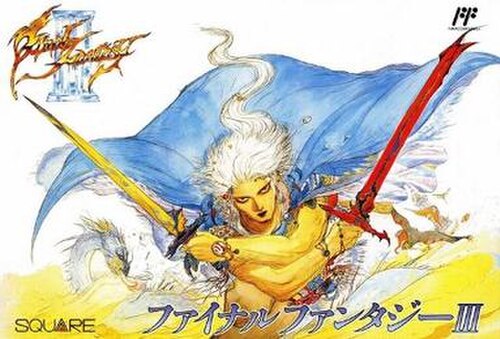
The History of Final Fantasy III
Final Fantasy III reached the Famicom on April 27, 1990, sold 1.4 million copies in Japan, and then vanished from the West's map for sixteen years. It is the game that gave the series its job system, its summoned monsters, and the moogle, and it squeezed all of that onto one of the biggest cartridges the Famicom ever carried.
THE MAKING
A struggle with data, finished in SacramentoThe veterans returned: Sakaguchi directing, Hiromichi Tanaka and Kazuhiko Aoki designing, Terada writing, Uematsu composing, and Gebelli programming for the last time in the series. Tanaka called development a struggle, a fight to use the game's limited data properly. The result needed a 512 KB cartridge, the Famicom's second highest capacity, and was described on completion as one of the largest games on the system. Midway through, Gebelli's visa expired again, and the staff again followed him to Sacramento to finish.
Two human notes belong in the record. Sakaguchi had previously not seen narrative as important; during production his mother Aki died in an accident, and his outlook changed, which he connected to the number of character death scenes he wrote into this game. And the final dungeon has no save points because, by the team's own account, a play tester complained the final area was too easy and Sakaguchi removed them in annoyance.
THE DESIGN
Jobs, capacity points, and the first summonsAfter the second game's experiment divided players, the battle system reverted to the traditional design of the first, and the invention moved elsewhere: to a job system, suggested by Sakaguchi to give players freedom to customize the party. The four orphans of Ur begin as Onion Knights and unlock jobs as the crystals bless them: warriors, monks, mages, dragoons with their jump, ninjas who can steal, and summoners, who call monsters into battle for the first time in the series. Changing jobs costs capacity points earned in battle, so experimentation is a resource, not a free habit.
Several arrivals here were refugees from the second game's cutting floor: summoned monsters and the moogles were both originally designed for Final Fantasy II and implemented here instead. Uematsu, working with new sound programmer Hiroshi Nakamura, used a little used fifth sound channel, one that normally triggered on bugs, to put a rolling drum beat under the battle theme, and settled the Prelude and the Main Theme as the series' recurring musical signatures.
THE EDITIONS
The versions, documentedTHE RECEPTION
Scores, sales, and the dissentJapan's verdict was warm and immediate. The West's verdict had to wait for a remake to exist, which is why this game is simultaneously a classic and, for many Western players, the series' missing chapter.
THE LEGACY
What it left behindThe job system prototyped here became the series' most reused inheritance, reaching its famous form in Final Fantasy V and Tactics. The moogle became a mascot, summons became spectacle, and the Onion Knight became the series' emblem for its own beginnings. Terada also adapted the game into a manga, his last work for the series he had written from the start.
THE GAME ON THE SHELF
Final Fantasy III · Famicom