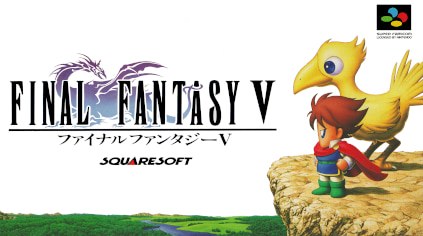
The History of Final Fantasy V
Final Fantasy V (Super Famicom, December 6, 1992) sends the wanderer Bartz and three companions to stop the sorcerer Exdeath from unsealing the Void. It never received a Super NES release outside Japan. Japanese players bought about 900,000 copies on its first day and 2.45 million in total, making it the second best-selling game of 1992 in Japan, behind only Dragon Quest V. The West waited until 1999 to play it officially.
THE MAKING
Square, 1992: a team of 45Sakaguchi directed, and before Final Fantasy IX he called V his favorite Final Fantasy. The scenario was a collaboration between Sakaguchi, who conceived and supervised the plot, and Yoshinori Kitase, who deliberately threaded humor through a serious story. Hiroyuki Ito designed the Job System and planned battles alongside Akihiko Matsui; Tetsuya Nomura designed the monsters; Kazuko Shibuya drew the characters and sprites over Amano's art.
The scale was new: a team of about 45 people and a 16-megabit cartridge holding the sprites, animations, and backgrounds. GamePro reported in May 1993 that Japanese authorities had asked Square not to release the game on a school day, because children would skip class to queue for it.
THE DESIGN
Jobs on jobsIII had introduced job changing; V rebuilt it into the series' deepest customization system. Four heroes can master 22 jobs, earning Ability Points alongside experience, and carry a learned ability into another job: a Knight who has trained as a Black Mage can take Black Magic into battle. V also added the visible ATB gauge, so players can finally see whose turn is coming, and introduced jobs that became series fixtures: Blue Mage, Time Mage, and Mime.
The story's other debut outlived the game: Gilgamesh, Exdeath's cheerful henchman and recurring mini-boss, went on to appear across the series. Uematsu planned more than a hundred pieces of music and cut the score to 56 tracks; one of them, Dear Friends, later gave its name to a Final Fantasy concert tour.
THE EDITIONS
The West that almost wasTHE RECEPTION
Loved for its systems, argued over for its storyThe split verdict became the game's permanent shape: nearly every later review, of the Anthology port and the praised Advance version alike, repeats it. The job system is called one of the series' most in-depth; the plot is called thin. Players who love systems call it the best of the 16-bit trilogy; players who love story rarely do.
THE LEGACY
Sakaguchi's favoriteV is the hinge of the Super Famicom trilogy: IV's drama on one side, VI's ensemble on the other, and underneath both, Ito's battle and job design, the mechanical line that runs from ATB through the job systems of later Square games, Tactics included.
Its afterlife is still moving. Nomura and Kitase have both said on record that they want to remake it, and the Pixel Remaster put the original, fan translation history and all, on modern shelves in 2021: the game the West was once told it could not handle.
THE GAME ON THE SHELF
Final Fantasy V · Super Famicom