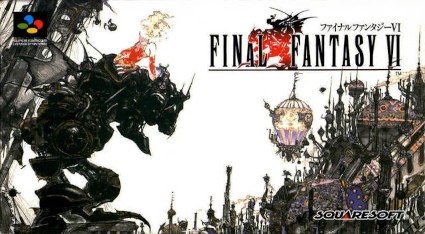
The History of Final Fantasy VI
The last 2D mainline Final Fantasy, Final Fantasy VI (Super Famicom, April 2, 1994) is set in a world of steam and Magitek where an empire is strip-mining magic itself. North America received it on October 11, 1994 as Final Fantasy III. It sold 2.55 million copies in Japan, the best-selling game of 1994 there, and 3.48 million worldwide by 2003, even though Sakaguchi himself said it was not a commercial success in the United States.
THE MAKING
One year, about thirty people, two new directorsVI was the first mainline entry directed by someone other than Sakaguchi. Promoted to Executive Vice President in 1991, he produced, and split direction between Yoshinori Kitase, who ran events and scenario, and Hiroyuki Ito, who ran all battle systems. Development took about one year with a team of roughly thirty, large for the time.
The premise was that every character is the protagonist. In what Kitase called a hybrid process, the whole team contributed characters and their episodes: Terra and Locke from Sakaguchi, Celes and Gau from Kitase, Shadow and Setzer from graphic director Tetsuya Nomura, Edgar and Sabin from field graphic designer Kaori Tanaka. Kitase provided the story's signature beats himself: the opera scene, Celes' cliff scene, and every appearance of Kefka. The team split the game in half, Balance and Ruin, because, in their words, they were tired of the common scenario of the hero narrowly saving the world. In VI, the villain wins at the midpoint, and the second half is played in the wreckage.
THE DESIGN
An ensemble machineThe cast is the system: fourteen permanent playable characters, the most in the main series, each with a unique command, from Locke's Steal to Sabin's martial arts inputs. Magic is taught through magicite, the remains of Espers, so almost any hero can learn almost any spell while staying distinct. Its low-health Desperation Attacks are the direct ancestors of the Limit Breaks of VII.
The presentation pushed the cartridge: the world map renders in Mode 7, character sprites keep the same resolution in and out of battle so faces can act, and Nomura drew the final boss, the Statue of the Gods, by scanning his hand sketches straight into sprite form. Uematsu's score runs on leitmotif, one theme per character, and ends with a 17-minute final battle suite, Dancing Mad, and a 21-minute Ending Theme that weaves every hero's theme together.
THE EDITIONS
Sold in America as Final Fantasy IIITHE RECEPTION
The standard, with one famous shrugThe contemporary dissent came from an unlikely address. Nintendo Power praised the broadened scope and improved sound and graphics, then called the plot not particularly inventive and the story often sappy, not written for an American audience. The same magazine ranked it the eighth greatest Nintendo game three years later. The argument and the canonization arrived together, and never really separated.
THE LEGACY
The end of the pixel era, by design and by accidentSquare's next step explains VI's place. Testing for VII began on Nintendo 64 hardware, with Terra, Locke, and Shadow rendered in 3D for a famous SGI demo, before cartridge costs and CD capacity moved the series to PlayStation and ended Square's Nintendo era; VI was the last mainline Final Fantasy on a Nintendo platform until Crystal Chronicles in 2003.
Thirty years on, the anniversary interviews returned to the same word: culmination. Nomura called VI the culmination of the pixel art era, and its structure, a first half of gathering heroes and a second half of finding them again, player-driven, is now routinely cited as a pioneering draft of the open world RPG. Of the three Super Famicom Final Fantasy games, it is the one the others are measured against.
THE GAME ON THE SHELF
Final Fantasy VI · Super Famicom