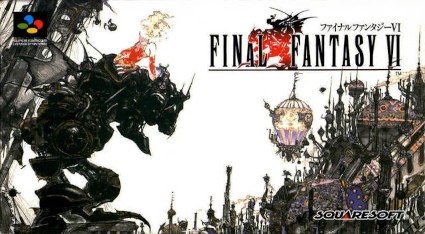
Why does Final Fantasy VI have an opera scene?
The opera is not decoration bolted onto a fantasy RPG. In the development record for Final Fantasy VI (1994), the opera scene is credited to Yoshinori Kitase, who ran the game's events and scenario: the same writer responsible for Celes' cliff scene and for every appearance of Kefka. Opera and the fine arts run through the whole game's design as recurring motifs, documented in developer interviews and the remaster materials.
Inside the story, the scene does real work. The party needs an airship, and the only airship belongs to Setzer, a gambler who has announced he will kidnap Maria, the opera's star. So Celes, herself a former imperial general, takes Maria's place on stage, in costume, and sings the performance while the plot closes in around her: Locke fights the comic villain Ultros in the rafters to keep the show from collapsing, literally, and Setzer's abduction arrives on cue at the finale. A heist, a rescue, and a recruitment, staged as a night at the opera.
The music is the famous part. Nobuo Uematsu composed the Aria di Mezzo Carattere for the scene, and the Super NES version performs it with a synthesized voice harmonizing with the melody, because the console's SPC700 sound chip could not carry a real vocal track. The workaround became the signature: players in 1994 had never heard a game cartridge attempt to sing an aria at them, in any voice at all.
The afterlife kept upgrading the voice. The arranged album Final Fantasy VI Grand Finale recorded the aria in Italian, sung by Svetla Krasteva with orchestra; Orchestral Game Concert 4 performed the full opera live with three singers; and the Pixel Remaster of 2022 finally recorded real opera singers for the scene, in seven languages: Japanese, English, French, German, Italian, Spanish, and Korean. What began as a scenario writer's scene and a sound chip's limitation ended as the most performed set piece in the series.
THE GAME ON THE SHELF
Final Fantasy VI