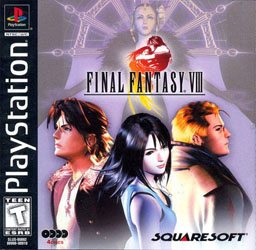
The History of Final Fantasy VIII
Final Fantasy VIII (PlayStation, 1999) had the hardest job in the series: follow Final Fantasy VII. Director Yoshinori Kitase and his team answered by changing almost everything, the character proportions, the magic system, the way heroes get paid. It sold 2.21 million copies in Japan on its first day, a single day record, and more than 9.6 million copies by August 2019, while critics argued about its systems in print and never really stopped.
THE MAKING
Square, 1997 to 1999Development began in 1997, while Square was still localizing Final Fantasy VII into English. Kitase directed, Shinji Hashimoto produced, Kazushige Nojima wrote the scenario, and Tetsuya Nomura and Yusuke Naora led the art. Nobuo Uematsu composed the score, and in a series first the theme was a vocal piece: "Eyes on Me," performed by Faye Wong.
Kitase has said the team wanted a brighter counterweight to VII's darkness, a story about young people at school: the mercenary academy Balamb Garden, and its cadets, the SeeD. The parallel story of Laguna Loire was originally planned at roughly the same volume as Squall's; Kitase later acknowledged that Squall's story took over and many Laguna scenes were cut.
The game was also Square's first extensive collaboration between its Japanese and North American teams during production. Lead translator Richard Honeywood built a text parser that converted English text automatically into the format the engine required, streamlining the localization dramatically.
THE DESIGN
Draw, Junction, and no magic pointsBattle designer Hiroyuki Ito built the game around summoned monsters called Guardian Forces. Junctioning a Guardian Force to a character unlocks that character's commands and lets the player equip stocked spells directly onto statistics: an offensive spell on Strength, a curative spell on HP. Armor and accessories, the series' usual stat machinery, were removed entirely.
Magic itself became inventory. Spells are drawn from enemies, draw points, and refined items, stocked up to 100 per spell, and spent one at a time. There are no magic points. Enemies scale with the party's average level, so grinding levels can make the game harder; power lives in the Junctions, not the levels. Kitase later said the team deliberately walked away from "defeat the monster, get money and experience": SeeD are salaried, paid on a timer, which drew its own complaints.
Around the battles sit the era's most famous minigame, the card game Triple Triad, which Kitase has said he modeled on the way Magic: The Gathering filled a whole world, and interactive Limit Breaks that ask for timed inputs instead of just watching.
THE EDITIONS
Four discs, then a remasterTHE RECEPTION
Acclaim, and the argumentTHE DISSENT
Kept, as printedThe argument was always the systems. PlayStation Magazine called the Junction system a major flaw for its repetitive stocking of spells. IGN praised the game and still called its battle system the weakest aspect. Electronic Gaming Monthly went the other way, calling the character development the best of any RPG and the game the pinnacle of its genre. Kitase, looking back in 2019, said the reviews at the time were "kind of all over the place," and that he still enjoys finding forum posts titled "Actually, Final Fantasy VIII was pretty good."
THE LEGACY
The fastest seller, then the slow reappraisalCommercially there was no argument: roughly 2.57 million copies in Japan within four days, more than $50 million in North America in thirteen weeks, the fastest selling Final Fantasy until the multi-platform Final Fantasy XIII, and 8.15 million copies shipped by March 2003. The ballroom dance scene was famous enough to serve as a PlayStation 2 technical demo in 1999.
Its reputation since is the interesting part: a top tier seller and a 90 on Metacritic that the fan conversation treats as the series' divisive one. The 2019 remaster put the argument in front of a new generation, models rebuilt, Junctions intact, salary and all.
THE GAME ON THE SHELF
Final Fantasy VIII · PlayStation