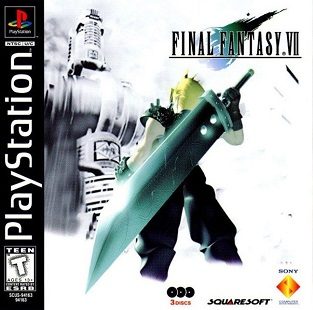
The History of Final Fantasy VII
Final Fantasy VII (PlayStation, 1997) follows Cloud Strife, a mercenary who joins the resistance group AVALANCHE against the Shinra Electric Power Company, and ends up chasing Sephiroth, a fallen hero who means to wound the planet itself and be reborn as a god. It was the first game in the series built in 3D, the first to use full motion video, and the first to be released in Europe at all. Square and its partners spent roughly US$80 million developing and marketing it, a figure no RPG had ever carried. It remains the best selling game in the series, and it is credited with boosting sales of the PlayStation and popularizing Japanese role-playing games worldwide.
HOW IT WAS MADE
Square, 1994 to 1997Concept talks began in 1994, straight after Final Fantasy VI, with series creator Hironobu Sakaguchi stepping back to producer and Yoshinori Kitase directing. The plan was a 2D game for the Super Nintendo. An early prototype was built, then shelved while the team finished Chrono Trigger, and discussions resumed in 1995 with a harder question attached: stay with 2D, or gamble on 3D and new hardware.
They gambled, and then the hardware fight decided the game's fate. Tests were built for the cartridge based Nintendo 64, using its planned 64DD disc peripheral, and they failed early: a single Behemoth monster needed 2,000 polygons and strained the machine into a low frame rate, and the finished game would have needed an estimated thirty 64DD discs. Cartridge prices were also climbing and narrowing Square's audience. Against that, Sony's PlayStation offered the storage of CD-ROM. Square moved Final Fantasy VII, and every other planned project, to the PlayStation.
The scale that followed was unheard of for the genre. Development cost an estimated US$40 million. Between 100 and 150 people finished the game in just over a year, at a time when a typical team was twenty, split between Square's Japanese offices and a new American office in Los Angeles. The studio bought SGI Onyx supercomputers and 3D software for an estimated $21 million, much of it technology the staff had never touched. Tetsuya Nomura took his first role as a main character designer, Yusuke Naora directed the art, Yoshitaka Amano drew the Meteor logo, and Sakaguchi's Materia system, paired with Nomura's Limit Breaks, rebuilt character customization around equipment any fighter could carry.
The signature bet was film. A new Square subsidiary, Visual Works, produced around forty minutes of computer generated FMV with an international team that included artists who had worked on Star Wars, Jurassic Park, Terminator 2: Judgment Day, and True Lies. Real time models were cut directly into the footage, most famously Cloud leaping onto an FMV train. Composer Nobuo Uematsu scored it like a film, and closed the final battle with "One-Winged Angel," the first vocal track in the series, assembled over two weeks from short unconnected phrases under the influence of Stravinsky's Rite of Spring and late 1960s rock.
THE RELEASE
Three discs, three continents, one campaignAnnounced in February 1996 and shown as a playable demo at that year's Tokyo Game Show, the game slipped almost a full year so the team could finish the vision. It launched in Japan on January 31, 1997, published by Square, and sold over two million copies in three days. By the end of 1997 it had sold 3.27 million units in Japan alone, according to Weekly Famitsu.
The West was the risk. Japanese RPGs were still a niche abroad, and Square had little Western publishing experience, so Sony took the publishing rights for North America and Europe on a royalties deal meant to match what self-publishing would have earned. Sony and Square then ran a three month campaign worth an estimated US$40 million worldwide, $20 million of it in North America: television spots alongside Saturday Night Live and The Simpsons, comics advertising, a Pepsi collaboration, and sample discs. North American retailers broke the street date to meet demand. The game arrived on September 7, 1997, sold 330,000 copies in its debut weekend and 500,000 in under three weeks, and passed one million in North America by early December. Europe followed on November 17, the first Final Fantasy ever released there, and for the first time a Western release kept the Japanese numeral: this was VII, not a renumbered sequel.
The editions kept coming. On October 2, 1997, Japan received Final Fantasy VII International, a re-release rebuilt on the enhanced Western version, which started Square's long habit of improved International editions. Eidos published a PC port on June 25, 1998, in a distinctive trapezoidal box: Eidos had forecast 100,000 sales on a $1.8 million contract, and the port went on to sell over a million. The English localization, handled in house by a team of about fifty under a sole translator, Michael Basket, was the one part of the launch nobody praised, and Square rebuilt its localization process because of it.
HOW IT WAS RECEIVED
Near unanimous, with the dissent keptThe perfect scores stacked up: A+ from 1UP, 5 of 5 from AllGame, Next Generation, and both official PlayStation magazines, 20 of 20 from GamePro, and four straight 9.5s from Electronic Gaming Monthly, which named it Game of the Month. GameFan called it "quite possibly the greatest game ever made," a line Square printed on the back of the box. The complaints were real and specific: a linear path, a translation the Official U.S. PlayStation Magazine called "a bit muddy," and, for IGN, a three character party limit as the game's only shortcoming. The awards followed the scores: the Grand Prize, Scenario Award, and Sound Award at the second CESA Awards, and Console Adventure Game of the Year and Console Role-Playing Game of the Year at the inaugural Interactive Achievement Awards.
WHAT IT LEFT BEHIND
The long tailThe PlayStation version alone had sold 9.8 million copies by the end of 2005, four million of them in Japan, making it the best selling Final Fantasy of its era. Worldwide sales across versions passed ten million by May 2010 and 13.3 million by June 2020, and the original version had sold over 15.3 million units by September 2025. Analysts at the time credited the launch with redefining what an RPG could sell in the West, and the game is still routinely placed among the greatest and most influential ever made.
Its scenes became the genre's shared memory. Aerith's death is still cited as one of the most significant moments in any game, and scholars of the medium hold the story up as the landmark use of the unreliable narrator in an interactive work, since the player experiences Cloud's false memories as fact. The world kept expanding: the Compilation of Final Fantasy VII added the film Advent Children and the games Before Crisis, Dirge of Cerberus, and Crisis Core, and a full remake trilogy began with Final Fantasy VII Remake in 2020 and continued with Rebirth in 2024. Cloud and Sephiroth, meanwhile, became fighting game regulars across the industry, a habit that started early. Which raises the one question this shelf asks about them.
THE QUESTIONS
Asked about this gameTHE GAME ON THE SHELF
Final Fantasy VII · PlayStation