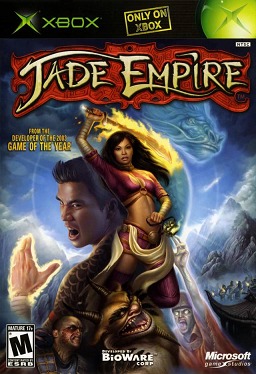
The History of Jade Empire
Jade Empire (Xbox, 2005) is the odd one out in BioWare's golden run, on purpose. Between licensed triumphs in other people's universes, Dungeons and Dragons and Star Wars, the studio built its first original role-playing world: a mythic China of martial arts, ghosts, and a celestial bureaucracy, with a language invented for the game. It reviewed like a flagship and sold like a footnote, and its co-founder has explained why, on the record. That explanation has its own question page in this Library.
THE MAKING
A dream project since the founding of the studioDevelopment began in May 2001. Co-founders Ray Muzyka and Greg Zeschuk, the game's executive producers, had carried the concept since BioWare's earliest days, alongside the plan that became Baldur's Gate: a “dream project” meant to fulfill player fantasies of becoming a powerful martial arts master. Around 105 people worked on the game full time. Jim Bishop directed, Luke Kristjanson and Mike Laidlaw wrote, and Jack Wall composed the score.
The world was researched as a collage with rules: art director Matt Goldman drew on the Han and Ming dynasties for the setting's frame, Song dynasty landscape painting for the environments, Tang dynasty greens for the palette, and Shang and Zhou bronzes for the ancient artifacts, with styling elements from Japan, Thailand, Tibet, and beyond. A constructed language, Tho Fan, was created for the setting's ancient tongue. The morality system evolved from Knights of the Old Republic's into the philosophies of the Open Palm and the Closed Fist, framed by intent rather than simple good and evil, and combat went real time, martial arts styles swapped on the fly, the studio's biggest mechanical break with its own past.
THE DESIGN
The last Spirit Monk, and a master who is the storyThe player is the last surviving Spirit Monk, raised in the village of Two Rivers by Master Li, on a quest that begins as a rescue and becomes a reckoning with what the Jade Empire's savior emperor, Sun Hai, did to the Water Dragon and the dead. Followers fill the BioWare roles with local color: Dawn Star, who speaks with the dead; Sagacious Zu, a hermit with a past; the Black Whirlwind, a mercenary of great strength and little caution; and Silk Fox, a masked figure whose identity is the game's politest spoiler.
Structurally it is the KOTOR shape in a new skin, hub areas, companion conversations, moral choices with visible consequences, but shorter and more linear than its spacefaring sibling, a tightness contemporary reviewers noted on both sides of the ledger.
THE EDITIONS
The versions that existTHE RECEPTION
The scores, with the dissent keptTHE LEGACY
The original world BioWare walked away fromJade Empire proved BioWare could invent a world, not only inhabit licensed ones, and the lesson was immediately applied: the studio's next two flagships, Mass Effect and Dragon Age, were both original properties, launched at the starts of console cycles rather than the ends. Jade Empire itself received no sequel, which gives it a strange purity on this shelf: the complete BioWare Xbox RPG that belongs to no franchise.
Its Japanese release also makes it this gallery's quiet control case. The era's traffic ran both ways: Japan exported two games the West never got, and received this Western built vision of a mythic China three months after America did.
THE GAME ON THE SHELF
Jade Empire · Xbox