The History of Kingdom Hearts
Kingdom Hearts (PlayStation 2, 2002) is an action role-playing game from Square, built with The Walt Disney Company: a boy named Sora, separated from his friends when shadow creatures called the Heartless consume his island, travels from world to world with Donald Duck and Goofy, sealing each world's Keyhole and searching for the people he lost. Disney's animated films supply most of the worlds; Square's Final Fantasy series supplies the guest cast. It shipped over 5.6 million copies worldwide by the end of 2006, became one of the best selling PlayStation 2 games, and is now routinely placed among the greatest games ever made.
HOW IT WAS MADE
Square and Disney, 2000 to 2002The idea started in a planning conversation between producer Shinji Hashimoto and Final Fantasy creator Hironobu Sakaguchi about Super Mario 64. They wanted a game with the same freedom of three dimensional movement, and believed only characters as popular as Disney's could rival Mario. Character designer Tetsuya Nomura, overhearing them, volunteered to lead the project, and the two producers let him. Then came the famous elevator pitch: Hashimoto met a Disney executive in an elevator, Square and Disney having previously had offices in the same building in Tokyo, and pitched the idea directly.
Development began in February 2000, with a production team of over one hundred people drawn from both Square and Disney. It was Nomura's first time directing a game. Disney initially proposed building the game exclusively around Disney properties; Nomura rejected those proposals and insisted on an original main character and universe, which is how Sora, Riku, Kairi, and the Heartless came to exist alongside the licensed cast. The game started out gameplay first, with a simple story aimed at Disney's target age range, until Sakaguchi told Nomura it would fail if it did not aim for the same level as the Final Fantasy series. The story grew from there.
Even the name is a negotiation. Nomura took inspiration from Disney's theme parks, particularly the recently opened Animal Kingdom, and wanted to call the game simply Kingdom; the trademark could not be secured. When the team settled on hearts as the story's core, the two words combined into Kingdom Hearts. Nomura and his team chose the Disney worlds for distinct looks and interesting characters, and Disney, with support from its then president Bob Iger, set few restrictions on which worlds could be used, asking mainly that each character stay within the boundaries of their own film.
The music carried the same double signature. Yoko Shimomura composed and produced the score, blending arranged Disney melodies with original themes; the opening and ending orchestral pieces were arranged by Kaoru Wada and performed by the New Japan Philharmonic Orchestra. The vocal theme was "Hikari" in Japan and "Simple and Clean" in the West, both written and performed by Utada Hikaru, the only singer Nomura had in mind for it, and her first song for a video game. The "Hikari" single, released in March 2002, had sold over 860,000 copies in Japan by that August.
THE RELEASE
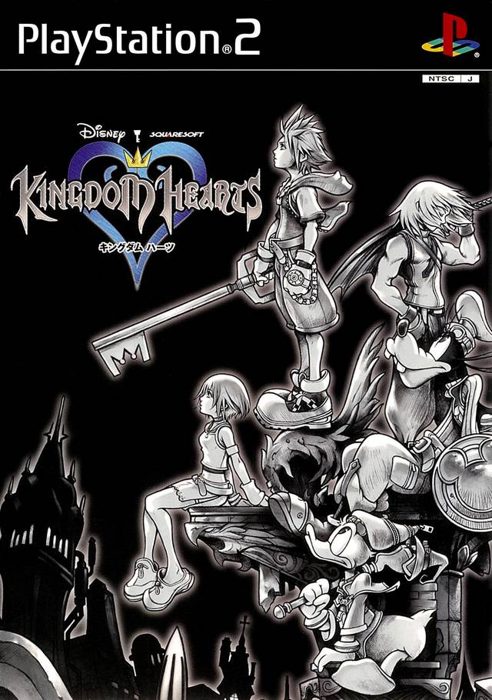
Three launches, then a fourth versionSquare announced the game at the Electronic Entertainment Expo in May 2001, and a playable demo followed at that year's Tokyo Game Show. Japan went first: March 28, 2002, published by Square. The Japanese box prints Nomura's ledge illustration in black and white; the American box, six months later, prints the same art in full color against a heart shaped moon.
North America followed on September 17, 2002, through Square Electronic Arts, and the American release was not a straight port. It added optional bosses the Japanese original never had, among them Kurt Zisa, named for the winner of the official website's Name-In-Game sweepstakes, an extra difficulty level, and a teaser for a sequel, hidden behind conditions Nomura set to gauge whether fans even wanted one. The English cast was led by Haley Joel Osment as Sora, David Gallagher as Riku, and Hayden Panettiere as Kairi, and a special effort was made to keep the Disney characters' official film voices wherever possible. Europe followed on November 15, 2002, published by Sony Computer Entertainment, and Australia on November 22.
Then the loop closed. On December 26, 2002, Japan received Kingdom Hearts Final Mix, an expanded re-release that folded the American additions back in and added more on top: new enemies, weapons, items, and cutscenes, and a new secret boss pointing at the sequel. Its dialogue stayed in English, with Japanese subtitles, and it was first sold packaged with either a deck of Kingdom Hearts playing cards or a special music CD; a limited Platinum Edition followed, with a Sora action figure, a sticker set, and sketches of the main characters. Final Mix was the definitive version of the game, and for over a decade it existed only in Japan.
HOW IT WAS RECEIVED
Acclaim, with the dissent keptReviewers praised the visuals, the voice acting, and Shimomura's score, and GameSpot named it the "Best Crossover Since Capcom vs. SNK" in its 2002 awards. The dissent is on the record too: the camera could frustrate, the combat was called tedious in places, and the Gummi Ship travel stages were widely judged the weak point, GameSpot calling them "pale imitations of the Star Fox series" while still finding the combat, particularly the boss fights, fun. GameSpy liked the package and faulted the plot for failing to gel when it finally built to its climax.
The sales matched the premise's reach. In its first two months in North America the game was one of the three highest selling video games on the market, and one of the top titles of the 2002 holiday season. By the end of April 2003 it had sold its millionth copy in the United States, earned PlayStation Greatest Hits status, and passed 3.0 million copies worldwide. By July 2006 it had sold 2.6 million copies and earned $100 million in the United States alone, and the NPD Group had listed it as one of the top ten best selling PlayStation 2 titles of all time in North America. The final documented shipping tally, as of December 2006, stands at over 5.6 million copies worldwide: 3.0 million in North America, 1.5 million in Japan, and 1.1 million in PAL regions.
WHAT IT LEFT BEHIND
A franchise, and a patternThe sequel teaser hidden in the American release found its audience. Kingdom Hearts: Chain of Memories followed on the Game Boy Advance in 2004 and Kingdom Hearts II in 2005, and the series grew into one of Square's most popular franchises, shipping more than 36 million copies worldwide by March 2022. The first game itself is recorded as the best selling Disney video game, and readers of Famitsu voted it the 19th best game of all time; IGN has placed it on its PlayStation 2 all time lists more than once.
It also set the series' defining pattern. Japan originates, America expands, Japan re-releases the expansion with interest as a Final Mix, and the rest of the world waits. The wait for the first Final Mix lasted eleven years, ending only when Kingdom Hearts HD 1.5 Remix carried it to the PlayStation 3 in 2013, a collection Western critics received at a Metacritic 77 and which has since been reissued again, with its sequel collection, on PlayStation 4, Xbox One, Windows, and Nintendo Switch. The HD rebuild was not simple: in June 2013 Nomura explained that the original game's assets had been lost, and the team had to dig the graphics out of the shipped game and recreate everything.
That is the first game's real legacy in one shape: a game born from an elevator conversation, rebuilt from its own disc a decade later because the world would not stop asking for the version Japan kept.
THE QUESTIONS
Asked and answered in the LibraryTHE GAME ON THE SHELF
Kingdom Hearts · PS2