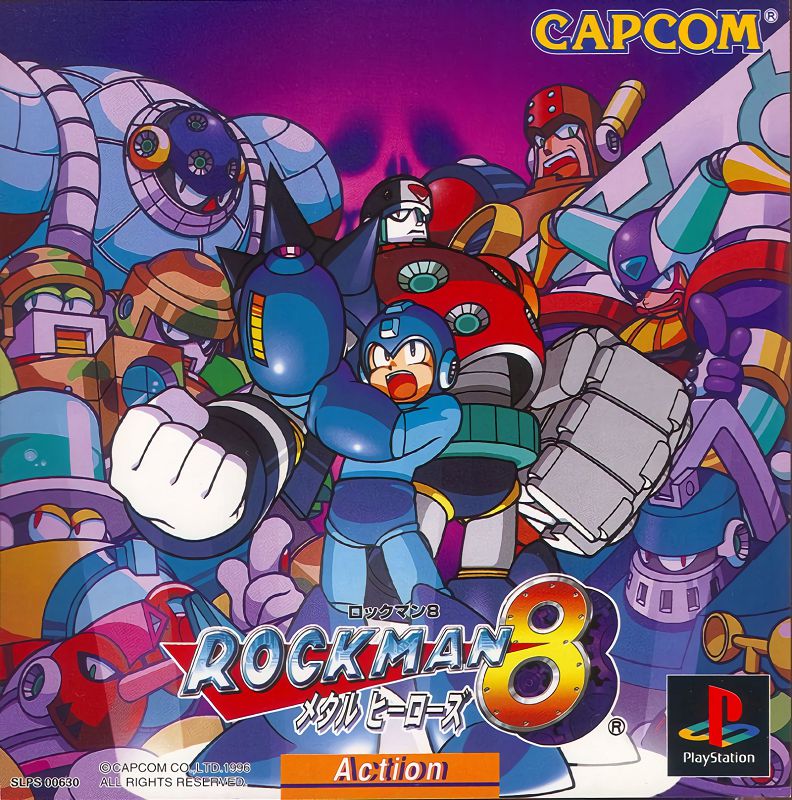
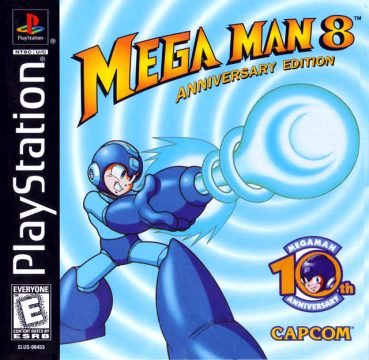
The History of Mega Man 8
Two alien robots crash to Earth mid duel, and the energy they carry, which Dr. Wily promptly steals, can corrupt any machine it touches. Mega Man 8, Rockman 8: Metal Heroes in Japan, launched in Japan on the PlayStation and the Sega Saturn across 1996 and 1997, reaching North America in 1997. It is the only numbered classic game not to debut on a Nintendo console, the series' tenth anniversary title, and the one that turned Mega Man into an anime cartoon between stages.
THE MAKING
Anniversary edition, in every senseCapcom marked the franchise's tenth anniversary on the box itself: the American release is badged Anniversary Edition, and limited copies carried a color history booklet, the Mega Man Anthology, celebrating the series so far. The game was the first in the classic series to tell its story with anime full motion video, and it introduced Duo, the alien robot hunting the Evil Energy across the universe, a character built to out scale everything the series had done before. The boss contest ran to 110,000 submissions, with rules attached: three of the chosen robots had to match requested shapes, one with a sword and a separable body, one with two heads, one with long extendable arms. Sword Man, Search Man, and Clown Man are those briefs, answered.
Mega Man can also, for the only time in the classic numbered series, swim. Energy Tanks, a fixture since Mega Man 2, are absent, also a series only.
THE TWO VERSIONS
The Saturn kept the extrasThe Saturn edition is not the PlayStation edition. It adds a Bonus Mode of official and fan artwork, voice and music tests, and two guests the PlayStation never got: Cut Man, an optional encounter, and Wood Man, a mandatory mini boss, appear as fights, each carrying a bolt that lies in the open on PlayStation. Tengu Man's stage has an entirely different song on Saturn, Aqua Man's is moodier and more widely arranged, and the returning bosses bring their original Mega Man 2 era themes with them, remixed. The water ripples, the sound is encoded differently, and the videos compress differently: two genuinely different objects under one title.
Every later collection quietly settled the argument by porting the PlayStation version, which is why the Saturn extras stayed a Japan era footnote for most Western players.
THE RECEPTION
Welcomed, a little coollyTaken for what it is, Mega Man 8 is the classic series at its most produced: voiced, animated, and orchestral in ambition, and still, structurally, eight Robot Masters and a fortress. Its historical weight is positional. It carried the classic line onto 32-bit hardware, kept it alive while the X series took the spotlight, and its assets, its villain, and its look were valuable enough that Capcom built the next game directly out of them.
THE GAME ON THE SHELF
Mega Man 8 · 1996