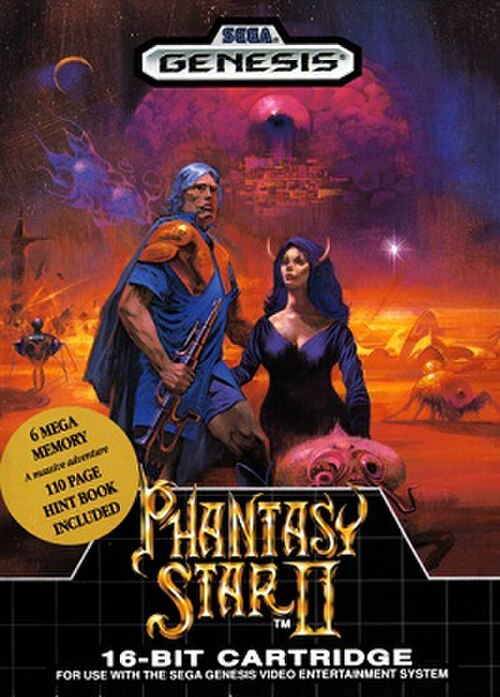
The History of Phantasy Star II
Phantasy Star II (Mega Drive, Japan March 21, 1989; North America March 1990) took Sega's Master System series onto the new hardware a thousand years later: the planet Mota, terraformed by the computer Mother Brain, is producing biomonsters, and agent Rolf is sent to learn why. It was directed by Chieko Aoki, produced and programmed by Yuji Naka, with art by Rieko Kodama and music by Tokuhiko Uwabo.
THE MAKING
A Master System plan, rebuilt for Mega DriveThe game began as a Master System sequel and was reworked for the Mega Drive midstream; a vestigial item in the finished game is still named for the older machine (Tier 2: the 1993 developer interview translated by Shmuplations, opened for this page). What shipped was a technical statement: a 6 megabit cartridge, the largest video game on any console at the time, holding a quest contemporary reporting estimated at some 250 hours.
The shift in hardware changed the view. The first game's first-person dungeons were dropped for a top-down world and third-person battles, with a party of up to four drawn from eight characters, each with their own weapons, armor, and techniques.
THE DESIGN
A utopia with a switch, and a death that stayed famousThe design's engine is its setting: a paradise administered by a machine, and a population gone soft inside it. The story turns on Nei, a girl who is part human and part biomonster, and on her confrontation with Neifirst, the experiment she was split from. Nei's death a third of the way through the game became one of the most cited story beats in the medium; IGN, ranking the game in 2003, chose it partly for how it surprised everyone with that death years before later, more famous examples.
The ending reverses the standard invasion plot: the villains behind Mother Brain are Earthlings, survivors of a destroyed Earth who built the system to dominate a peaceful world, and the game closes on the party facing them with Algo's comfortable age declared over.
THE EDITIONS
One cartridge, a book, and a long reissue tailTHE RECEPTION
Acclaim, with the grind kept in viewThe dissent is structural and has never gone away: the dungeons are vast mazes that are near impossible to navigate without a map, and the difficulty demands long stretches of level grinding. Computer Gaming World's Roe R. Adams, a Wizardry designer, called it a system seller for the Genesis all the same, praising the science fiction story over the graphics.
THE LEGACY
The template the genre grew fromNintendo Power called it a game of many firsts: the first RPG for the Mega Drive, on sale in America four months before the original Final Fantasy reached the NES. GameSpot inducted it into its greatest games list in 2005; Electronic Gaming Monthly ranked it the 30th best console game of all time in 1997, calling it the best RPG on the Genesis for its characters, story, enemies, and massive length; Nintendo Power in 2009 named it, with Phantasy Star IV, one of the greatest role playing games of all time.
Its documented influences run forward: an epic, character driven storyline with serious themes, social commentary years before the Final Fantasy series attempted it, and a predominantly science fiction setting at a time when RPGs were almost all fantasy.
THE GAME ON THE SHELF
Phantasy Star II · Genesis