The History of Phantasy Star IV: The End of the Millennium
Phantasy Star IV (Japan December 17, 1993; North America February 1995; Europe November 1995) is the last game of the original tetralogy and still the last traditional RPG in the series. A thousand years after Phantasy Star II, the climate machines of Motavia are failing and hunters Alys Brangwin and Chaz Ashley trace the collapse to the Profound Darkness. It was directed by Rieko Kodama, Toru Yoshida, and Kiyoshi Takeuchi, with art by Yoshida and music by Izuho Takeuchi and Masaki Nakagaki.
THE MAKING
A sequel that announced which game it was followingIn Japan the game was announced as Phantasy Star IV and renamed before release to Phantasy Star: The End of the Millennium, a title the gaming press of the time read as a deliberate signal that this was the follow up to Phantasy Star II, jumping over III's side story. The American and European boxes restored the IV, while every version's title screen reads The End of the Millennium.
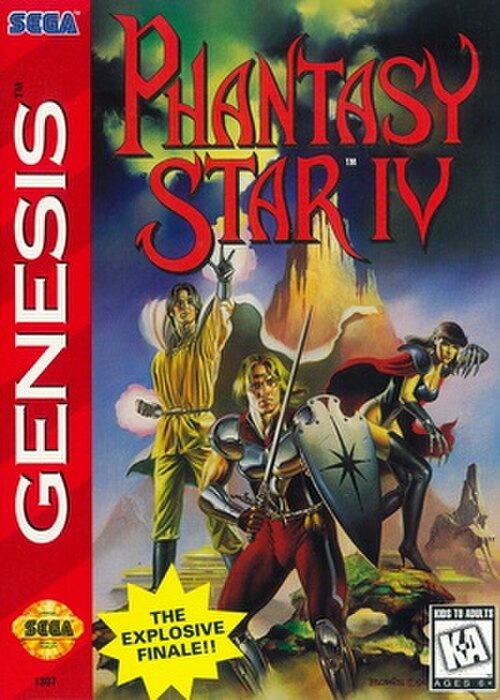
The Western cover is its own artifact: painted by Boris Vallejo, it shows Chaz, Rika, and Rune, and deviates from how all three look in the game. Compare it on the gallery shelf with the game it contains.
THE DESIGN
Manga panels, macros, and the missing fifteenth comboThe storytelling changed format: the plot is carried in manga style panel illustrations, a first for the series, inside an expanded script. Combat added combination techniques, attacks produced when characters' skills are used together. The American manual states there are 15 possible combination attacks; only 14 were ever discovered, and the useless technique Feeve, reachable only by hacking, is sometimes mistaken for the lost fifteenth. The argument is documented and unresolved, and this page leaves it that way.
Alys's death at Zio's hands gives the game the series' second famous loss, structured as a passing of the lead role itself: Chaz finishes the game as its protagonist.
THE EDITIONS
The near $100 cartridgeTHE RECEPTION
Divided in 1995, canonized sinceThe contemporary split is consistent: EGM's crew found the gameplay highly involving and the graphics mediocre and the music irritating; GamePro praised the macros, the talk option, and the story sequences while calling the story frequently incoherent. Mean Machines Sega split the difference and named it the best pure RPG for the Mega Drive. The retrospective record settled it: Complex ranked it the second best Genesis game of all time, IGN placed it 61st among all games in 2007 and 59th in its Top 100 RPGs in 2012, and Nintendo Power named it with Phantasy Star II one of the greatest RPGs ever made.
THE LEGACY
The end of the millennium, keptThe series stopped here as a traditional RPG; the next Phantasy Star was Online in 2000, a different kind of game with an unrelated story. IV's reputation has only grown inside that frame: it is the consensus peak of the Genesis RPG shelf, the standard the machine's other RPGs are measured against. Why it holds that place, and what its price history has to do with it, is the subject of the Library's flagship question for this era.
THE GAME ON THE SHELF
Phantasy Star IV · Genesis