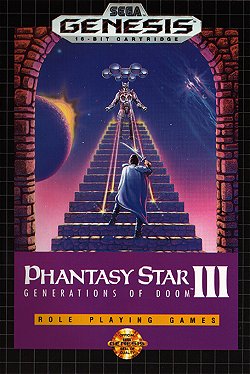
The History of Phantasy Star III: Generations of Doom
Phantasy Star III (Japan April 21, 1990; North America June 1991), known in Japan as Successors of Time: Phantasy Star III, follows Prince Rhys of Landen and his descendants across three generations of a feud between the Orakians and the Layans. It was directed by Hiroto Saeki, produced by Kazunari Tsukamoto, with character designs and cover art by Saru Miya and music by Izuho Numata. It is the first game in the series made without co-creator Yuji Naka.
THE MAKING
A new team, on purposeAfter Phantasy Star II, most of its staff moved on to Sonic the Hedgehog. Phantasy Star III was built by a new team of developers who had never made an RPG before, assisted in planning by series veteran Rieko Kodama. Producer Tsukamoto later described it as closer to a collection of side stories than to the connected narrative of II and IV, and said the altered graphic style followed from the different team.
To stand out in a crowded RPG market the team built the game around branching narrative paths. Storage limits fought them the whole way: parts of the narrative were cut to fit the features, the multiple endings proved difficult to implement, and designer Hirondo Saiki, the sole designer, was fatigued by the later stages. Numata, two years into her Sega career, found composing for an RPG a challenge in itself; her plan for music that changed with the party roster was cut back to music that changes with the party's size.
THE DESIGN
Marriage as a game mechanicAt set points the hero must marry one of two women. The choice decides the next generation's hero, the child of the previous lead, and changes what the party can do: an Orakian hero and a mixed Layan and Orakian hero differ in their techniques and proficiency. Two paths in the second generation open into four in the third, and each of the four final heroes reaches a different ending.
Under the fantasy surface sits the series' science fiction: both factions descend from survivors of Palm, the planet destroyed in Phantasy Star II, and their kingdoms are sections of a vast colonization spaceship. Combat kept the series' turn based shape and added an auto battle option and an icon based menu, a menu idea that carried into 1991's Shining in the Darkness.
THE EDITIONS
A cartridge that travelled inside collectionsTHE RECEPTION
Loved on arrival, argued about ever sinceThat split is the game's permanent reputation. Contemporary reviewers praised the generational plot; retrospective critics cite the subtle differences between the endings, weaker battle animation, and an unresolved cliffhanger inherited from Phantasy Star II. Nintendo Power in 2009 called it the series' lackluster third installment, and it is now routinely described as the black sheep of the series, while Mega had ranked it 12th in its Top Mega Drive Games of All Time back in 1992. Both records are printed here because both are true.
THE LEGACY
The experiment the series never repeatedNo later Phantasy Star returned to the generational structure, which is exactly why this one keeps being written about: it is the series' one attempt to make lineage itself the mechanic, made by a team learning the genre as they went. Its defenders, Kotaku among them in 2020, call it flawed but ambitious, and that pairing has become its settled description.
THE GAME ON THE SHELF
Phantasy Star III · Genesis