
The History of Phantasy Star Online
Phantasy Star Online (Dreamcast, 2000) took Sega's oldest RPG series into instanced, four player online dungeons years before console online play was normal. It sold 75,000 copies on its first North American day, passed 235,000 registered players worldwide by April 2001, won Japan's Game Award for Game of the Year, and outlived its own servers: the last official ones closed in 2010, and fan servers keep the game playable now.
THE MAKING
Sonic Team, under ordersSega chairman Isao Okawa believed the internet was the future and ordered a flagship online game for the Dreamcast. No studio volunteered; the assignment fell to Sonic Team, who were not receptive, under producer Yuji Naka and director Takao Miyoshi. Naka sent progress reports to Okawa's hospital after the chairman fell ill. Okawa personally paid for a year of free internet access bundled with Japanese Dreamcasts, because Japanese dial up was billed by the minute and would have strangled the game at birth.
The team's network experiments first shipped as ChuChu Rocket! in 1999, the Dreamcast's first online game. For the RPG, Naka studied Diablo, Ultima Online, and EverQuest, and took Diablo as the main model (Tier 1: he was determined to outclass it), deliberately not building an MMO: persistent world servers would have taken two years of programming, and the Dreamcast had no hard drive. The project, working title "Third World," became a Phantasy Star game when artist Satoshi Sakai's dragon sketch reminded Naka of the series; its story is deliberately unrelated to the earlier games. The team had once conceived a four player online Saturn game, Burning Rangers, and abandoned it over network problems. This time the network was the point. Player versus player combat existed in press betas and was cut, as a distraction from cooperation. Composer Hideaki Kobayashi's adaptive score, melodies sequenced by gameplay, crashed the build so often the staff nicknamed it "the crasher."
THE DESIGN
Built to cross languagesFour hunters leave the starship Pioneer 2 for the planet Ragol, in instanced dungeons rather than a shared world. The design's quiet masterpiece is its communication system: Word Select, a library of roughly 2,000 preset phrases that auto translates between Japanese, English, Spanish, German, and French, so a party could coordinate across languages with no shared tongue, backed by Symbol Chat pictograms and Swatch Internet Time as a universal clock for arranging meetings. Sega even bought and named a star "Ragol" on the International Star Registry. The Japanese beta went to 10,000 pre order customers, and 90 percent of them got online, the proof of concept the whole design rested on.
THE EDITIONS
One party portrait, two packagingsThe same crew, framed by region
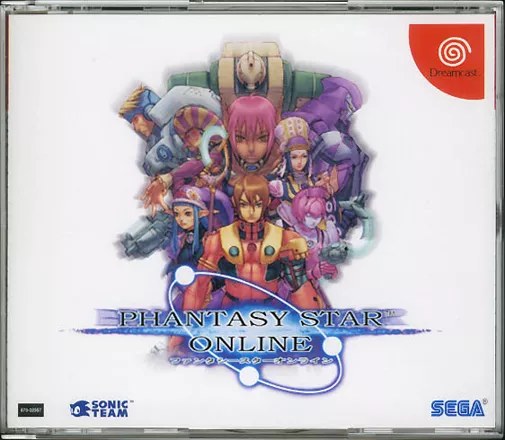
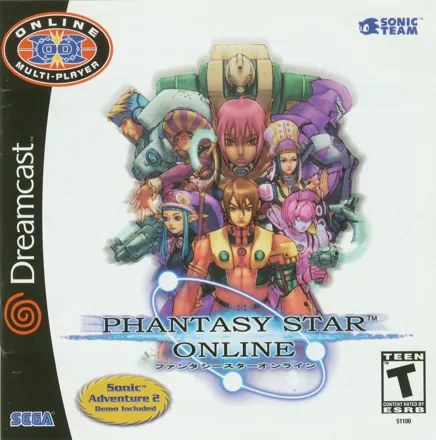
The first 100,000 Japanese pre orders also received branded dog tags. Europe followed on February 15, 2001.
THE RECEPTION
Revolutionary, with one standing warningThe anticipation had been extraordinary: CVG called it "arguably the most revolutionary console game ever" before release, and Edge wrote that its multiplayer "would lay the foundations for a new era of console gaming." The launch numbers were strong and still short of Sega's hopes: nearly 100,000 registered before the Western launch, over 235,000 by April 2001 (130,000 in Japan, 70,000 in North America, 35,000 in Europe) with a peak of 26,000 concurrent players, against internal expectations of 500,000 in Japan and a million worldwide. Cheating and item duplication emerged within weeks, an architectural consequence of the peer to peer design, and bans began in May 2001. None of it reversed the verdict: the first successful console online RPG had happened, on a console that was already being discontinued.
THE LEGACY
The servers are fan run nowPhantasy Star Online is recognized as the template later console online games and dungeon crawlers, Monster Hunter among them, built on. Naka's own prediction closes the record: that future gamers would laugh at "Online" being in the title at all, the way no one labels a game "3D" anymore. The official infrastructure is gone, the last server closed on December 27, 2010, but private fan servers keep Ragol inhabited, which makes the Dreamcast disc something unusual on this shelf: not a sealed artifact of a finished thing, but a key to a place its players refused to let close.