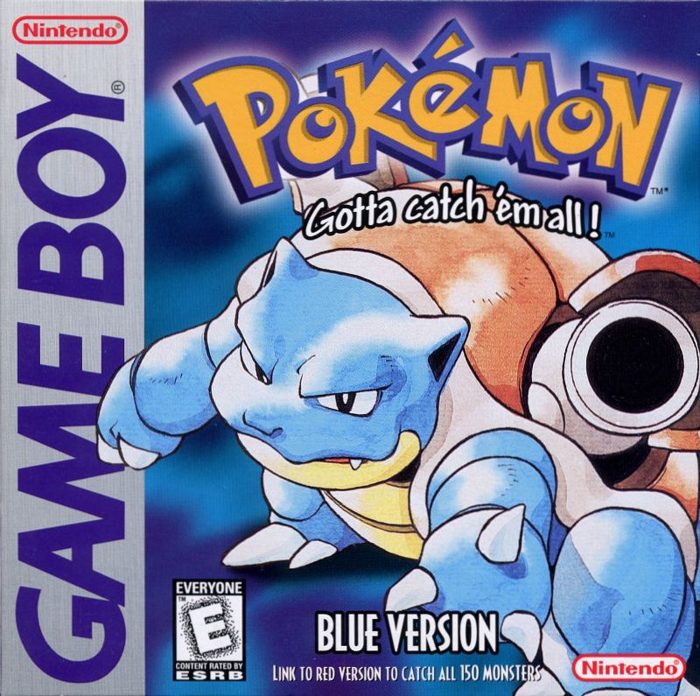
The History of Pokémon Red and Blue
Pokémon Red and Pokémon Blue are the first installments of the Pokémon video game series, developed by Game Freak and published by Nintendo for the Game Boy. They were first released in Japan as Pocket Monsters Red and Pocket Monsters Green on February 27, 1996, followed by the special edition Pocket Monsters Blue later that year. The games reached the rest of the world in 1998 and 1999 as Red and Blue.
The design made one cartridge deliberately incomplete. Each version holds only part of the 151 Pokémon, certain Pokémon evolve only when traded, and the Pokédex, the in-game encyclopedia, can only be finished by trading between two games over the Game Link Cable. Collecting was built as a social act from the first day.
HOW IT WAS MADE
Game Freak, 1990 to 1996Game developer Satoshi Tajiri pitched the concept of Pokémon to Nintendo's staff in 1990 and was met with skepticism: the ideas were thought too ambitious, and the appeal hard to see. Shigeru Miyamoto saw the potential, and convinced the company to go ahead with the project.
The initial concept stemmed from the hobby of insect collecting, a popular pastime Tajiri enjoyed as a child. As the town where he lived urbanized and the insect population declined, and as children played indoors instead of outside, he imagined a game of creatures that resembled insects, which children could name individually and control. Pokémon would never bleed or die in battle, only faint: Tajiri did not want to fill the gaming world with what he called "pointless violence."
The trading design came from a frustration. Playing Dragon Quest II, Tajiri tried and failed to obtain an item that dropped only rarely, while Ken Sugimori, playing the same game, had acquired two. There was no way to trade between Famicom games. When the Game Boy arrived, Tajiri thought the system was perfect for his idea, especially because of the link cable. In his words: "I imagined a chunk of information being transferred by connecting two Game Boys with special cables, and I went wow, that's really going to be something!" Connection cables had previously been used only for competition; using one to trade information was new to the industry. Miyamoto then suggested creating multiple cartridges with different Pokémon in each, noting it would assist the trading aspect.
Sugimori, an artist and longtime friend of Tajiri, headed the drawings and designs of the Pokémon, working with a team of fewer than ten people who conceived the designs for all 151. Atsuko Nishida created the designs for Pikachu, Bulbasaur, Charmander, Squirtle and many others, and Sugimori finalized each design, drawing it from various angles for the graphics department. Junichi Masuda composed the music, using the four sound channels of the Game Boy for the melodies, the sound effects and the Pokémon cries; he wrote it at home on a Commodore Amiga and converted it to the Game Boy with a program he had written himself.
The game was originally called Capsule Monsters, a name drawn from the Capsule Monsters of the television series Ultraseven, and passed through CapuMon and KapuMon amid trademark problems before settling on Pocket Monsters. Development was completed by October 1995, and release was planned for December 21, 1995, but it was delayed until February 27, 1996 because the derivative products were not yet ready for sale. Inside the finished games sat one secret the plan never called for: the Pokémon Mew, added by programmer Shigeki Morimoto as an internal prank and not intended to be exposed to consumers. Tajiri later revealed it deliberately, believing it "created a lot of rumors and myths about the game" and "kept the interest alive."
THE RELEASE
Japan 1996, the West 1998The Western games are not simple translations of Red and Green. During localization, a small team led by Hiro Nakamura went through the individual Pokémon, renaming them for Western audiences based on appearance and characteristics, and Nintendo trademarked the 151 names. The translation team found that simply altering the text was impossible: the games had to be entirely reprogrammed from scratch, because of the fragile state of source code produced over an unusually lengthy development. So the Western editions were based on the more modern Japanese Blue, modeling their programming and artwork on Blue while keeping the same distribution of Pokémon found in the Japanese Red and Green cartridges.
The crossing nearly changed the creatures themselves. The Western localization team warned that the "cute monsters" might not be accepted by American audiences and recommended they be redesigned and "beefed up." Nintendo president Hiroshi Yamauchi refused, viewing the possible reception in America as a challenge to face instead. Nintendo spent $13 million marketing Red and Blue in the United States, and the original designs stayed.
The documented sales are the scale of what followed. In Japan, Red, Green and Blue ultimately sold 10.23 million copies, and until November 2022 they stood as the country's best selling video games. In the United States the pair became the fastest selling Game Boy games to that point, selling 200,000 copies within two weeks and 4 million units by the end of 1998, and they reached a combined 9.85 million United States sales by 2007. Worldwide, sales of Red and Blue passed 31 million copies.
HOW IT WAS RECEIVED
The scoresThe argument around the games was about what mattered. Papers published by the Columbia Business School up to 1999 indicated that American and Japanese children preferred the actual gameplay of a game over special audio or visual effects, and the lack of those effects was said to promote the child's imagination and creativity. The Guardian put it plainly: "With all the talk of game engines and texture mapping and so on, there is something refreshing about this superlative gameplay which makes you ignore the cutesy 8-bit graphics." At the Academy of Interactive Arts and Sciences' 2nd Annual Interactive Achievement Awards, Red and Blue won Outstanding Achievement in Character or Story Development, alongside nominations for Console Game of the Year, Console Role Playing Game of the Year, and Outstanding Achievement in Interactive Design.
WHAT IT LEFT BEHIND
The template for a franchiseRed and Blue are widely credited with starting and paving the way for a multibillion dollar series, and with revitalizing the Game Boy in the late 1990s: the website 1UP.com ranked them first among "late to the party" games and called them Nintendo's "secret weapon" on the platform. The series that grew from them has since sold over 300 million games, a total accredited to the enormous success of the original pair.
The rankings never cooled. Nintendo Power listed Red and Blue together as the third best video game for the Game Boy and Game Boy Color. IGN placed the pair at number 72 on its Top 100 Games of All Time in 2003, noting the games "started a revolution," then at 70 in 2005, then at 37 in 2007, where its reviewers wrote that the unique blend of exploration, training, battling and trading "actually forced the player to socialize with others in order to truly experience all that it had to offer." In 2017, The Strong National Museum of Play inducted Pokémon Red and Green into its World Video Game Hall of Fame.
The originals kept being tended and remade. FireRed and LeafGreen, enhanced remakes of Red and Blue for the Game Boy Advance, arrived in 2004 and sold around 12 million copies worldwide between them. On the twentieth anniversary of the Japanese release, in February 2016, Nintendo re-released Red, Blue and Yellow on the Nintendo 3DS Virtual Console with simulated Link Cable functionality, a first for the service, and combined sales of the re-releases reached 1.5 million copies by March 31, 2016, more than half of them in North America. Even the audience became part of the record: in February 2014, Twitch Plays Pokémon turned a modified copy of Red over to a chat room averaging 50,000 simultaneous participants, and the crowd finished the game on March 1, 2014, after 390 hours of non-stop play.
THE QUESTIONS
Asked and answered in the LibraryTHE GAME ON THE SHELF
Pokémon Red and Blue · Game Boy